
The Incredible Hulk (2008)
- Introduction: Nothing Ever Happens
- Section 1. Mere Anarchy.
- Section 2. The MCU’s Prometheus.
- Conclusion. Hollow Man
- Post Credit Scene Review.
Introduction: Nothing Ever Happens
The phrase “Nothing Ever Happens” first cropped up on 4chan in the mid-2010s. It was borne of the frustrations with the lack of economic, political, and social change that users of the /pol/ board felt was rife in the 21st Century. From the perspective of those who coined the phrase, while the 20th Century had been full of meaningful events that caused rapid and substantial change, in the 21st Century, nothing happened. To an extent, this idea isn’t baseless. You can list off major tragedies and events from the last two decades like a modern cover of “We Didn’t Start the Fire” – Take Back Wall Street, the Black Lives Matter movement, Sandy Hook, the COVID-19 pandemic, the Panama Papers, Luigi Mangione, so on and so on, but there seems to be no lasting impact. These are things that should have forced society to look at and address its inherent inequalities, but in the long run, that change never came about. Inequality across all major axes is as pronounced as it has ever been, and revolutionary movements, no matter the type, seem to amount to nothing. But whether the phrase is accurate or not, it undoubtedly has its problems. Given it came from 4chan, I’ve always felt it has an inherent connection to reactionary politics, which gives me reason for pause. Unlike a lot of Anons, I’d contend that the dominance of western power and the perfidious influence of capital are incentivised to quash revolutionary action and maintain the status quo. I don’t trust that whoever first used the phrase didn’t think that it was the consequence of a shadowy cabal of woke moralists puppeteering George Soros, Putin, and Mark Zuckerberg. Additionally, when studying history, one must be aware of how time dilates. Studying history is very different to living through it, and while some irony poisoned 21-year-old might see how the events of 1945 impacted events in 1955, that causality is not as automatic or as simple as it seems. Consequently, any commentary about Nothing Ever Happens, or the End of History, I think must be taken with a seriously large grain of salt. Unless you’re talking about The Incredible Hulk (2008). Nothing ever happens in that fucking movie.
This is to say, that I don’t think it has a full grasp of the idea of cause and effect; that things that happen in the plot ought to have some kind of significance. This, I think, is one of my biggest frustrations with the movie. On several occasions characters or plot devices are introduced, only for them to never appear again, or just not mean anything. The movie seems hell-bent on taking the audience's hand and leading them straight into a dead-end. Instead of doubling back or tying itself in knots to try and explain its incoherencies, the movie chooses instead to just ignore them. Upon arrival at a dead-end, you just push through, and end up in a completely different part of the plot, from where you can kind of muddle forward. The most common kind of dead-end is the character dead-end. Here you follow characters down their own little winding paths, only to be suddenly met with a big brick wall with the words “FUCK YOU THEY DON’T MATTER” spray-painted brazenly across its face. Dead-ends also crop up in both plot and theme, both of which in my opinion are far more egregious, in which the movie does a one-eighty on the direction one might naturally assume it was going in. I’ve said before that I have no desire to turn these posts into a kind of tirade on how people should make movies; I’m willing to believe that the people who made The Incredible Hulk (2008) are professionals with a better understanding of movie making than me. As a result, I think most of the feeling of emptiness, and inconsequentiality, that pervades the movie can be chalked up to a handful of understandable mistakes. The pressures of the market, the studio, the vision for the MCU, and scenes and ideas needing to be cut for time, all render the foibles of the movie perfectly explicable. But they don’t explain everything, and I’ll be damned if I let them off the hook that easily.
Thinking back to the Iron Man (2008) post, elephant-brained readers will recall that I tried my best to put some structure on it. That structure was based, predominantly, on the narrative and character structures of the movie. It followed the journey of Tony Stark and his relationship to the Iron Man suit, and how these two disparate things came together to form a new, superheroic identity. As unadventurous as Iron Man (2008) was, it was competent, and capable of communicating sets of ideas beyond what was literally playing out on screen. The same cannot at all be said for The Incredible Hulk (2008). It is a cruder, and less refined movie, and as a result I feel I have woefully less material to work with when it comes to finding a neat structure for what I’m trying to write. So, instead, I will be structuring this post around dead-ends, and their causes. I will not be attempting to provide a blow-by-blow account of the plot; I watched the movie almost a year ago at this point and while my memory of it is fine, there are definitely some details that I’m missing. Instead, this post will be divided into two sections. In the first, I’ll discuss the emptiness of the movie; the characters it forgets about, the vapidity with which it treats the characters it remembers, the plots that it drops, and the ideas it refuses to engage with. Throughout this first section, the goal is to communicate how careless I find the movie and lay out why I think that. Then, in the second, I will attempt to offer an explanation as to why the movie is careless, how both internal and external factors killed The Incredible Hulk (2008) stone dead.
Section 1. Mere Anarchy.
Have You Seen This Person?
In the opening scenes of the movie, we find Bruce Banner tucked away safely in a favela in Rio de Janeiro. We more or less know that Bruce has been on the run, but it seems as though he’s been making a nice little life for himself here. He has his own place, his own dog, a meditation/fighting instructor, a little briefcase computer where he talks to his Discord scientist boyfriend, and a job at a local bottling plant. Idyllic. It is at this bottling plant where we find the first character to be introduced and then dropped; a female co-worker of Bruce’s. Throughout the scenes at the plant, the pair exchange a couple of glances at different points, clearly establishing a kind of romantic tension. This dynamic continues into a further scene, in which this co-worker is approached and harassed by an unruly gang of male bottling plant workers on their lunch break. They make a number of crude remarks, and she’s clearly uncomfortable, until Bruce Banner, paragon of virtue and moral fortitude, intervenes and saves the day. She is clearly grateful, and forgive me for speculating, but all of this struck me as a textbook establishment of a love interest. Which, to be clear, I wasn’t mad about. I spent a great deal of the Iron Man (2008) post talking about how textbook that movie was, and my final verdict was it came out fine. If anything, I was intrigued by the idea of having a love interest, or sidekick, who not only wasn’t Bruce’s mainstay girlfriend back in the US, but who also didn’t really share a language with him. The communication barrier could have had interesting ramifications, especially when Bruce becomes Hulk and loses his ability to communicate altogether. But, given how this whole section is about dead-ends, it should be no surprise that none of this comes to pass. Despite the clear set-up for a love interest, the female co-worker is dropped several scenes later. After the incident in the bottling plant, she doesn’t meaningfully show up again until Bruce is attempting to run from the spec ops team the US military send into Brazil (which, in light of recent events, unfortunately no longer seems far-fetched). As he sneaks out of his own house, he ends up hiding out in hers for all of ten seconds, and then it’s time for the high-octane chase through the streets of Rio. That’s it. She never shows up again. Ultimately, Bruce Banner’s love interest ends up being his girl from back home, Dr. Betty Ross.
Incidentally, the next character on the list of dead-ends is Dr. Betty Ross’s boyfriend, Phil Dunphy from the hit American sitcom, Modern Family. There aren’t a lot of great shots of him from the movie, but here’s the best I could find from a quick trawl of Google images, just to prove I’m not lying.
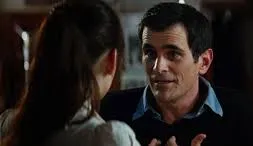
This guy isn’t a huge deal, and for the most part, he exists to communicate the fact that a lot of time has passed since Bruce became Hulk, and that Betty has moved on. He’s a pretty chilled out guy, all things considered. He’s a great partner to Betty, he doesn’t seem to mind too much that Bruce starts hanging around, and similarly doesn’t even really seem to mind when Betty ends up leaving him to get back with Bruce. According to the Hulk wiki, which my housemate Seán checked for me, he seemed to always be aware that Betty was still in love with her old partner. That’s not to say he’s into being cuckolded or anything, but I think it’s more so indicative that this guy is emotionally mature and has his head on straight. His only real contribution to the plot is, after Hulk and Betty run off to the mountains, he confronts US General Thaddeus Ross. Phil tells Thaddeus that he’s been a real dickhead to his daughter and he should maybe consider being less of a prick. In theory, this could be read as having some kind of purpose; while he never appears in the movie after telling Thaddeus off, it could be read as him having some kind of role to play in the grander narrative. I would contend, however, that these don’t count at all.
Phil Dunphy isn’t exactly a small fish in the world of The Incredible Hulk (2008). He shows up in a good few scenes, and has plenty of (mostly meaningless) dialogue. He exists and is present in the plot, but to very little end. To the extent that he is relevant, it has little to do with his own character, outside of his role as Man-That-Betty-Ross-Was-Always-Going-To-Dump. On a meta-textual level, this is also a heap of wasted potential. Phil Dunphy isn’t just playing a guy to be dumped, he’s playing a known and established Marvel character – Doc Samson – who my housemate reliably informs me is a superhero therapist. In The Incredible Hulk (2008) he has much the same role, only he’s a regular therapist instead of a superhero one. In no way does the movie need to pivot to be about him, but it refuses to make use of this character. Hulk is a character inherently wrapped up in mental health and neurological processes. Tony Stark in Iron Man (2008) is too but, differently. Hulk’s entire conflict is about his ability to control his emotions, to stay calm and regulated, to not lose his cool. Further, what does becoming Hulk feel like; what happens to your mind when seemingly something else completely takes over. The separation between superhero and civilian identity is something I expect to be explored in a number of these origin story movies, and Hulk is one of the few characters in the early MCU line up for whom his mind is a crucial, fascinating element of his character. The Incredible Hulk (2008) introduces the superhero therapist and decides never to use him; to let him fade into obscurity after giving one ineffectual tear down of a US army general. A dead end.
Last, but certainly not least, on the list of forgotten side characters is Bruce Banner’s Discord boyfriend. He is first introduced back when Bruce is still in Brazil, although we don’t get a glimpse of his face until late in the movie. He’s referred to by his codename, Mr. Blue, and he plays the role of Bruce’s scientific confidant. We know at this point that Bruce is a genius, both from the general cultural understanding of Hulk as a character, and from the snapshots of backstory offered in the opening credits. However, without access to any laboratory instruments in Brazil, Banner is dependent on a US based scientist he can trust to work on figuring out what exactly is going on with this Hulk thing. Mr. Blue is that very scientist. Humorously, the interactions between these two leads to the most bullshit techno-babble the movie has. They talk about “data” and “samples”, without any indication of what those are, and without any respect for what they might be. A whole section of the movie is dedicated to Bruce trying to get his hands on “the data”, the acquisition of which is positioned as having the answer to all of Bruce’s problems. Along these lines, Mr. Blue has a significantly larger role to play in the movie. His presence has real, tangible effects on both the progression of the plot and Bruce’s identity, as Mr. Blue gives him a real shot at attempting to discover more about himself and his condition. Eventually, however, he gets caught in the crossfire of the US military trying to get at Bruce. Mr. Blue helps Emil Blonsky, a violent spec ops soldier who became obsessed with Hulk after encountering him in Brazil, become Abomination (the main villain of the movie), by giving him a high dose of Hulk Juice. As Abomination busts aggressively out of the lab, Mr. Blue is knocked down with a cut on his head, which Hulk Juice then begins dripping into. This is the final scene we see him in; his head hits the floor as green veins start popping up over his face, and a grisly smile creeps over his face.
Mr. Blue had dedicated the last several years of his research life to studying Banner’s blood and had, in the process, synthesised a large supply of Hulk Juice that he believes can be used as a medicine (with, of course, the downside of turning you into a huge monster). This in turn leads to an interesting conflict for Hulk. Banner believes the supply should be destroyed regardless of whatever medicinal potential it may have, clearly indicative of how he views his own condition as a dangerous burden. Mr. Blue’s death being brought about by his own research is a poignant, and definitionally tragic one, but that’s where it ends. There are no consequences for this death, and moreover, it means nothing for Banner. I’d like to contrast this with the character of Yinsen in Iron Man (2008), as I think there are parallels. Yinsen helps Tony build the first prototype of the Arc Reactor and sacrifices his own life to propel Tony on his journey of heroism and self-discovery. Like Mr. Blue, Yinsen is a scientist with a connection to the hero, who allows the hero to consider their own condition. But unlike Mr. Blue, Yinsen’s death is meaningful, not just to the narrative, but to Tony. Mr. Blue’s death, by contrast, means nothing. It has no impact felt anywhere; nobody cares, and he is not seen or referenced again, despite the fact that he is a clearly important character whose appearance on screen has been implicitly built up throughout the movie. Mr. Blue dies, and nothing happens.
The sum total effect that these dead-end characters have, for me, is they make the film seem flaccid, and confused. Upon their introduction to the narrative, their role seems clear, almost painfully telegraphed. The female co-worker is going to be his love interest, Phil Dunphy (aka Doc Samson) is going to help Bruce interrogate or control his feelings, and Mr. Blue is going to help him realise the truth of who he is. These character archetypes may not be interesting, or complicated, but they’re sensible. Much like with Iron Man (2008), these set up familiar, expected plot beats that align with what I assume is the shared vision of these early MCU movies; to make money, and to launch something astronomically larger than themselves. But that’s not how it shakes out. Instead, who we expect these characters to be is subverted, and not in an interesting way. There is no unexpected take on their roles, no twist or complication. Rather, the subversion comes through their total annihilation. Narrative objects necessarily imbued with meaning are robbed of it, and if this was supposed to be an interesting position for the movie to adopt, I don’t think it works. Instead, the movie is cheapened; it doesn’t seem to know who its most important characters are, and there is little difference between how relevant characters are introduced (think Dr. Betty Ross, General Thaddeus Ross, Abomination, etc), versus the ultimately irrelevant characters (those discussed in this section). As the movie fumbles around in the dark, so too do the audience, desperately trying to latch onto something meaningful and familiar. That meaning never comes, or at the very least, does not come where it ought to.
Have You Seen This Plotline?
Having explored how The Incredible Hulk (2008) fails to live up to promises it makes on character arcs and roles, I’d like to briefly explore examples of how the movie fails to deliver on promises made with regard to plot and theme. The first of these comes at you fast, with the opening credits hinting at a movie and a narrative that simply never materialises. The opening credits are made up of two main elements; flashbacks into the life of Bruce Banner, and images and animations that flesh across the screen to achieve an aesthetic effect. It brings me some amount of embarrassment to admit that this was my favourite part of the movie. Not that I’m personally embarrassed, more that I’m embarrassed on the part of the movie’s creators. If the best set of five continuous minutes in your entire piece is the five minutes where the movie is very specifically not happening, that’s a bad sign. But, with that in mind, I do genuinely contend that the opening credits are pretty good. They excited me, mostly because, in getting all the backstory out of the way early, I felt as though I was being promised a movie that wasn’t a simple origin story. We hit all the main story beats in how Bruce Banner becomes Hulk. We see Bruce working for some government/military laboratory and being so confident in his work that he offers himself up as the test subject, we see him give one last confident wink to his girlfriend Dr. Betty Ross, only for him to Hulk out, lose control, and injure her. Once he’s back to human form, Bruce gets kicked out by General Thaddeus Ross, after which, he flees. I am generally going into all the early MCU movies with the assumption that they’re going to be origin stories that trace how a person becomes the hero we know. By getting that all out of the way first, I felt as though I was being promised a backstory-free picture that maybe could deal with the complexities of Bruce, Hulk, and the surrounding cast without being bogged down in a formulaic, paint-by-numbers narrative.
The suggestion of a break with formula is heightened by the aesthetic framing of the opening credits. The cast’s names come into view and fade away again, all over a murky black background that appears laced with fog. Dull, green lightning bolts cut through that murky black, in a way reminiscent to me of brain scans – like little Hulk neurons firing off across the hero’s grey matter.
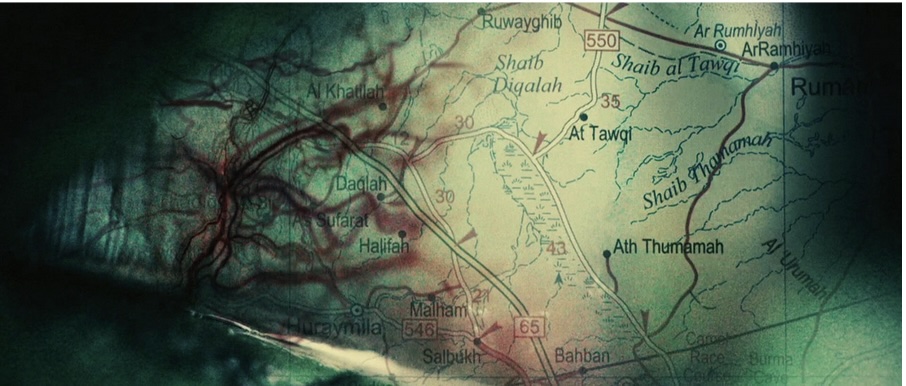
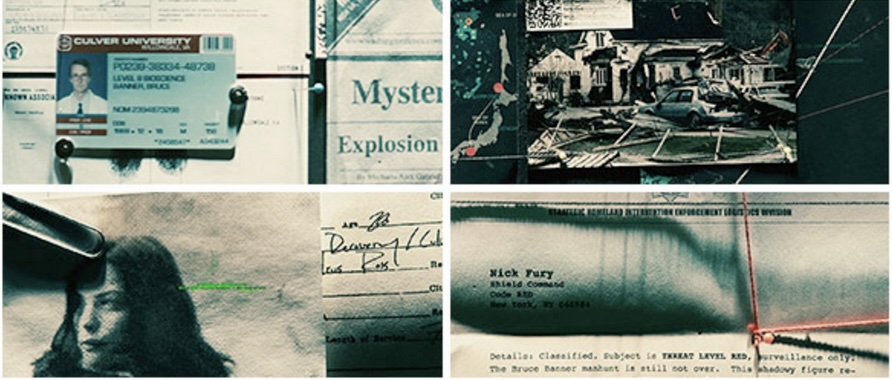
Throughout all of this, and interspersed with the flashbacks already mentioned, assorted images of newspaper clippings, blurry photos, government reports and redacted police files all flash onto the screen. These first and foremost aid in the communication of Bruce’s origin story, informing the audience that after Bruce got kicked out of his lab by Thaddeus Ross, he fled to the Mexican border, and from there made his way to Brazil. During this ordeal, he would spend time as both Bruce and Hulk, which resulted in rumours of a large green monster beginning to spread across the US and beyond. In addition, these images work to situate Hulk, and the movie at large, within a very particular thematic landscape. Taken together, they feel suggestive of Hulk as a cryptid, or even a serial killer. He is depicted for these brief few minutes as a folk-horror monster for which people have only vague, fragmentary evidence about, while shadowy government agencies know the actual truth. It felt like I was about to watch a true-crime documentary, or an episode of Criminal Minds that was trying really, really hard. Coupled with background black and green that create a neurological, almost psychiatric mood, I really thought for a moment that The Incredible Hulk (2008) was going to offer a new, and refreshing take on its subject. Naturally Hulk is always going to be about violence, rage, and beating dudes up, but the perspective and promises made by the opening credits suggest a movie that is going to be less concerned with the depictions of that violence, and more concerned with exploring what the effects of being, and being around, a lean green killing machine are.
In summary, the opening credits promise novelty, but that novelty never materialises. I, for all my folly, fell hook, line, and sinker for the idea that The Incredible Hulk (2008) might be an exciting movie. After fifteen minutes or so, still riding the opening credits high, I turned to Seán and said, “I have so much to say about this movie”. Somewhere, deep in my heart of hearts, I had a vision of the movie The Incredible Hulk (2008) could be. I saw a movie in which competing US factions, the military represented by Thaddeus Ross, and S.H.I.E.L.D. represented by Nick Fury, fought each other literally in Brazil, and politically in New York, to secure this legendary, unkillable, cryptid beast called Hulk. I saw a kind of psychological thriller in which the complexities of Hulk’s condition is addressed, as well as the horrifying reality of being the man-monster hybrid. I got none of this. After about forty minutes, my excitement lapsed, and once again sadly turning my head to Seán again, I said, “I have no idea what I could possibly say about this movie”. If the opening credits suggest, at their minimum, a mystery thriller that explores the complexities of Hulk’s psyche, the actual movie simply doesn’t. It’s a pretty standard action movie where Bruce tries his best to not get into trouble, and Hulk beats the shit out of guys, and the sum total exploration of Hulk’s condition comes when he flees from the military with Betty in tow. Ending up at a rocky cave in the middle of the night, Betty and Hulk have some clear connection, suggesting that against all odds, behind all the green and the muscle, Hulk is still Bruce Banner. That’s where this all goes. Dead-end.
Speaking of Hulk fleeing from the military, I’d like to spend a moment discussing the military and its role in The Incredible Hulk (2008). Increasingly, it's feeling more and more likely that I’m going to need to spend some time talking about the MCU and their relationship to the US military, and in that vein, I’d like to again point to the work done by Tom Secker and his efforts to acquire the correspondences between the US Department of Defence and Marvel Studios. I’m not relying on Tom’s work in this post, but I referenced him in the Iron Man (2008) post and anticipate referencing him further, so I figure I’d mention him here too. In any case, the perspective that The Incredible Hulk (2008) offers on the military is, for the bulk of its run-time, very different from the perspective offered by Iron Man (2008). In the latter, the military are servants of peace and justice, loyal to a fault, and defer to the enlightened and benevolent judgement of Tony Stark. They work with Tony extensively, and are passive observers of violence, rather than the perpetrators of it. On the other hand, the military in The Incredible Hulk (2008) are extremely active in committing violent acts. It is by military order that a spec ops team are sent into Brazil to apprehend Bruce Banner/Hulk, and the military hunt him throughout the movie. They are Hulk’s main antagonists, with multiple confrontations between not just him and individual bad actors (like Emil Blonsky and Thaddeus Ross), but also on-screen combat between Hulk and regular rank-and-file infantry. Granted, those regular rank-and-file infantry do shoot him with the Loud Noise Gun, which would make anyone mad, but still I think this nicely delineates the differences in the depictions of the military between these two first MCU movies. For much of the movie, the military have a role, and that role is the bad guys.
But of course, this could never last. As we learned from Iron Man (2008), if the US military show up in your movie then they’re going to have a say in how you present them. So, predictably, the military eventually have a change of heart. Thaddeus Ross sees the error of his ways for reasons, frankly, that I can’t remember. I have some vague recollection that it comes at the insistence of his daughter Betty Ross, who is repeatedly the instigator of changes-of-heart in this movie in a way that I think is politically kind of dubious. Her main role as inspiring peace or righteousness in the violent men that surround her is highly suspect, as far as I’m concerned, and a strong case that she never should have left Phil Dunphy, who wasn’t hell-bent on killing anyone. In any case, a combination of his daughter’s insistence that she loves the big green guy, and being confronted with the insanity of Emil Blonsky (whose motivation is to become Abomination such that he can defeat Hulk) eventually causes Thaddeus Ross to see the light and turn his guns to the aid of Bruce Banner. There was, for a while, an interesting comment on how blind hatred leads Thaddeus Ross to flaunt international laws, and engender a lack of care for regular people just trying to lead their lives. However, like with Iron Man (2008), the military is positioned as the perpetrators of reasonable, acceptable violence. People like Thaddeus Ross, or Blonsky can lead them down a dark path, but once they heal their interpersonal issues with their daughter and her green boyfriend, then they’ll only want to kill bad guys and that’s pretty cool. Any commentary on the military and their role in unsanctioned violence is scrubbed clean, attributed to the bad apples, and the movie moves on without any desire to return to the thematic elements it had previously engaged with.
I feel as though I’m beating the same drum over and over again. All these dead-ends, whether they’re related to characters or to plot and theme, all share a crucial commonality. Namely, the movie seems to be suggesting it will be going in one direction, and then never does. I feel like I need to defend myself here somewhat, because I can’t help but feel as though this is almost my fault. Am I the idiot for tricking myself into thinking that a movie was going to go a certain way? Am I the fool for being so set in my ways that when The Incredible Hulk (2008) doesn’t play out exactly how I think it will, I get frustrated? I think to an extent those arguments hold water – maybe if I was more open to just going along with the rollercoaster-esque flow of the movie, I would have enjoyed it more. But at the same time, I feel as though I’m completely in the right. It’s important to outright state that art is an act of communication. To adopt a very structuralist position: words mean things, shot choices mean things, acting choices mean things. An audience, in being presented with these individual pieces of information, internalises and interprets what is being communicated by them, and then comes to an understanding of the text. Familiar ideas, tropes, and story beats can be used as a kind of communication shorthand – in recognising things that we can expect to happen (even as simple a thing a Bruce saying “You won’t like me when I’m angry”), the labyrinthine complexities of artistic communication are simplified, and an audience are provided signposts along the journey of the narrative. After seeing a female co-worker who clearly likes Bruce, and who he saves from a gang of unruly dudes, it is not a huge leap to think “Oh, well this character means something to him, maybe she’ll be his love interest”. And when that never comes to pass, and all that time watching their dynamic comes to nothing, it fucking sucks. It's disorienting, and not in a way that feels purposeful. Rather, it feels confused. It introduces characters and ideas without any intention or belief that they can ever be fully realised, and so, instead of communicating anything meaningful, the half-formed, rough beast of The Incredible Hulk (2008) slouches towards the conclusion of its run time.
Section 2. The MCU’s Prometheus.
It didn’t have to be this way. That is my prevailing thought when I think about The Incredible Hulk (2008). It could have been so different, and it could have been so much better. Unfortunately, we’re left with the sad reality of what it is. What is even sadder is that I believe the creative team responsible for The Incredible Hulk (2008) knew that the movie could have been better; they saw in it a certain potential, but for one reason or another, they failed to allow it to live up to it. I say this because it is clear throughout the movie that there is a coherent vision, both aesthetically and thematically, that is simply too divergent from expectations to be allowed to thrive. In brief, there is a tension. On the one hand, you have a refreshing, engaged take on Hulk that is aware of what the character is, and how the semiotics of that character manifest in 21st Century culture. But on the other hand, you have the financial pressures of Marvel to create a successful movie to launch the MCU. I talked about this a little bit in the Iron Man (2008) post; Marvel was making two bets, one with Paramount as the distributor and another with Universal, and all they needed was for one of the two initial movies to take off, and they’d have their launching pad. That’s all just conjecture, but I think it's a sensible explanation for why the two first MCU movies released so close to each other; they were being made at the same time with the hope that they couldn’t both flop at once. Iron Man (2008), as I have mentioned before, is a perfectly competent movie that hits all the right beats and that makes the right character choices for financial success. The Incredible Hulk (2008), on the other hand, is stuck between trying to give the audience what they want (the path of financial viability), and presenting a more modern, compelling take on Hulk (the path of approximating artistic integrity). In the end, the inability of these two paths to co-exist, and the hemming and hawing of the creators over which path to follow, is what leaves the movie in its rough, misshapen state.
Now that’s all well and good, but what exactly do I mean when I say I believe the creators had a clear vision for a modern take on Hulk that they couldn’t bring about? Well, the first thing you have to understand is that Hulk is goth. Not in the sense that he yearns for the sack of Rome, nor in the sense that he wears all black (he wears purple, but not in this movie), but rather in the sense that there is a case to be made that Hulk fits the archetype of the gothic antihero. His story and character all have their origins in a number of seminal works of Gothic literature. Foremost amongst these is of course Dr. Jekyll and Mr. Hyde (1886), by Robert Louis Stevenson, in which a charismatic and handsome young doctor takes a serum that turns him into the murderous brute Mr. Hyde. This short novel explores the 19th Century’s changing conception of the human mind; theories of evolution and natural selection had highlighted how close to animals we were, and the emergent fields of psychology and psychiatry were dissecting the mind’s previously unknown workings. The focus on the mind as a shifting, nebulous thing that can be fundamentally altered through science lies at the core of Hulk, a character who mirrors Jekyll and Hyde almost exactly, as a talented man of science who transforms into a huge dude who is mad as hell. Hulk also bears similarities to the monster of Mary Shelley’s Frankenstein (1818), in which a young and brilliant scientist creates new life from cadavers.. However, Dr. Frankenstein is horrified by his creation, and the monster is rejected by and cast out into an unforgiving world. He attempts to learn about human love and empathy, but is spurned at almost every opportunity. Like with Mr. Hyde, Hulk and Frankenstein’s monster share a massive physical frame and impressive strength. Where they differ from Hyde is in how they act when they are not being a monster. Throughout Hulk-centric media, including The Incredible Hulk (2008), Hulk (and Banner) doesn’t really want to hurt anyone. He is a creature of emotion who is primarily driven by a love for his girlfriend Betty and a desire for his own safety, but the fear and rejection he engenders in humans through his terrifying physical differences causes them to attack him. At the very least, this is the case in The Incredible Hulk (2008). The same can be said of Frankenstein’s monster, who is driven to terrible acts of violence because of how humanity has hurt him, and through his own desire for companionship. Frankenstein’s monster and Hulk are both relegated to the fringes of human society, and forced to watch while the world chooses to disregard them.
I would also like to quickly add one final gothic text to the broader milieu from which Hulk draws from, namely The Island of Dr. Moreau (1896) by H.G Wells. Here a man comes to an island inhabited by the mysterious Dr. Moreau and his creations; strange half-human, half-animal hybrids. Dr. Moreau has been undertaking grisly acts of medical malpractice, in which he has been vivisecting animals and trying to force them into a kind of human shape. As a result, the island is populated by pigs, sloths, leopards, and so on, all of which have been contorted into gruesome approximations of humanity against their will. They can think and talk, and have their own laws and society. This text, like the other gothic texts mentioned, deals with the broader themes of the confluence of science and humanity, what it means to be human in the face of your own monstrosity, and where the bestial and the civilised diverge, or coalesce. I would contend that Hulk explores these very same ideas; he is a human being contorted into a fearsome and monstrous shape against his will, is locked in a constant battle between his bestial and human natures which is repeatedly enforced through his exclusion from standard human society. From a character standpoint, Hulk is a gothic character, and his tale is a gothic tale that grows from a long tradition of contemplating these questions. For its part, The Incredible Hulk (2008) is deeply aware of this connection to the gothic genre, and intentionally plays into the aesthetics.
For example, picture the following scene for me. It is a dark autumn night in London, some time in the mid-19th Century. Wisps of fog hang ominously over a city street, backlit by the gas lamps that line the pavement. Little puddles of water collect between the cobbles from earlier in the day, and while the rain has long since stopped, it is far too cold for the water to have evaporated yet. There is very little noise, but suddenly, the peace is broken by a large, dark figure stomping down the road. All you can see is the outline of his silhouette and the steam rising off his hulking frame, and while he makes no outwardly aggressive motion, you can feel the malice his presence exudes. Once you’ve pictured that, I want you to look at this image.
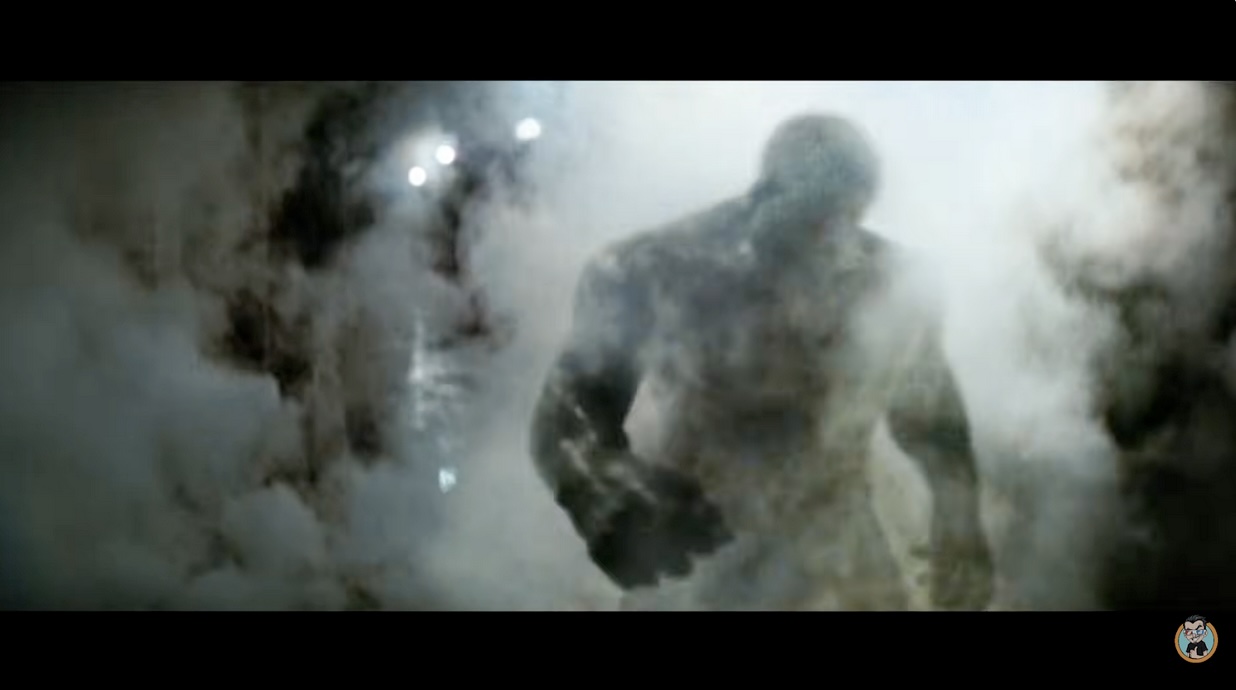
This is an image taken from the YouTube channel JoBlo Superheroes, who uploaded the fight scene between Emil Blonsky and Bruce Banner in the bottling plant in Brazil. While this is not the Victorian London street I asked you to imagine, to me, it has all the same signifiers. Hulk’s figure is ominous and shadowy, the city fog is replaced with steam from the machines, the gas lamps replaced with fluorescent factory lighting. There are even puddles on the ground for some reason. All of this, coupled with the shot composition, I think are meant to inspire a sense of the gothic. For all the world, this looks like it could be a scene from a modern remake of Jekyll and Hyde, but it's not. This is The Incredible Hulk (2008). Furthermore, this is far from an isolated incident. Throughout the entire movie, the images and aesthetics of the gothic are called upon to surround Hulk, with the clear intent to position him within the gothic context from which he so clearly grew out of. On Bruce Banner’s return to America following his Brazilian escapades, he finds and goes to the university where his ex-girlfriend now works. But rather than approaching her, which he cannot do on account of his status as a dangerous pariah, he chooses instead to watch from afar as she embraces her new boyfriend Phil Dunphy from Modern Family. Again, this scene could be taken right from Frankenstein, when the monster watches a quaint European family with longing as they care for one another. As a final point, when Bruce Banner at last meets up with Mr. Blue, they undergo a procedure which is supposed to test for an antidote to being the Hulk. This scene takes place in a modern day university laboratory, and while the overseer of the lab (Mr. Blue) is an admittedly erratic scientist, he is a modern scientist nonetheless. However, the slab that Banner is strapped into looks as though it was ripped right out of a gothic horror; an ugly, bulky chair with large leather straps for the patient's hands and feet. One imagines Dr. Frankenstein would have constructed his monster under similar conditions. There is no reason for the lab equipment to look like this, except for what I believe is its explicit intention to heighten the gothic elements of the scene. For this reason, alongside the host of other aesthetic choices, I have reason to believe that the creators of The Incredible Hulk (2008) were aware of Hulk and his gothic connections. They are aware that this is a character entrenched in questions of humanity, monstrosity, and the conflict between them.
What’s more, the connection the movie draws between Hulk and the gothic extends beyond set dressing. To this end, I would like to return again to the opening credits. Earlier in this post, I referenced how they filled me with a sense of optimism for The Incredible Hulk (2008); they seemed to suggest a psychological thriller of a movie that pulled from the popular 2000s tropes of crime procedurals, serial killers, cold cases, and cryptid hunting. To me, this smacks of the gothic, but specifically the gothic of the late 20th and early 21st Century. Of course, the gothic was originally a genre formed in and informed by the 19th Century, borne of a heightened anxiety that came with humanities advancing understanding of itself. What place, therefore, could it ever have as the 21st Century drew nearer and materialised?
As it turns out, it holds a very important place. From the gothic sprouted a number of other far more popular modern genres. Frankenstein (1818) is widely attributed with being the beginning of science fiction as we have come to understand it, and indeed, almost all the gothic texts referenced in this post bear some resemblance to science fiction. All of them feature scientists attempting to do something impossible, far beyond the scope of real science, that strikes a similar chord to the speculative fiction of Arthur C. Clarke and others of the 20th Century. Only instead of being fascinated by space and its mysteries, 19th Century gothic fiction was more interested in the mysteries of the human body. Furthermore, the beginning of crime fiction as a genre is broadly attributed to Edgar Allan Poe, a noted contributor to the gothic genre. His short detective stories featuring the Holmes-esque C. Auguste Dupin predate Arthur Conan Doyle’s detective by about forty years, as does Poe’s The Gold Bug (1843). While Conan Doyle may have had the most significant impact on what would become the genre of detective fiction, its origins are in the gothic. Alongside horror, these genres are the reincarnation of the gothic that has persisted into the modern day, and the links that persist between them cannot be ignored.
Serial killers, and cryptids to a lesser extent, are the modern gothic. They are the monsters that live amongst humanity that can never be found; like Hyde, and like Frankenstein. They are what dominated the narratives of crime and crime fiction from the 70s onwards, hall-marked today by the slough of true-crime podcasts, books, and articles that feel a dime-a-dozen. This, incidentally, is also a relatively gothic feature, feeling deeply reminiscent of the phenomenon of the Victorian Penny Dreadful. The figure of the serial killer replaced Frankenstein as the symbol of the monster that lurks within the human soul; if gothic texts were concerned with how monstrosity appears in humanity, the late 20th and early 21st Century did not need to rely on fabrications because the stories were on the news. They of course got blown out of proportion through media storms, and were eventually crystallised into narratives, but I digress. To me, the opening credits of The Incredible Hulk (2008) are an indication that the creators are aware of this. They know Hulk is a gothic character, they know what the modern gothic looks like, and they take great pains to represent this aesthetically. The movie looks, in many ways, like it should be a gothic tale. It should be a story about a man/monster wrestling with the two sides of his identity. They knew. They knew that's the story they should be telling. But they didn’t.
The Incredible Hulk (2008) gestures limply at the movie it could be. While it captures the imagery of a movie that could explore the complexities of what it is to be Hulk, it fails to actually deliver on it. They are vague hints here and there of Bruce Banner’s internal struggle, but they are surface level at best. In an early scene in Brazil, we see Banner’s martial arts teacher instruct him in how to control his breathing to calm down, a skill I can only assume he somehow had not yet learned. This cheapens Banner’s conflict in a sense; it draws your attention to Banner’s fear of losing his temper, but the solution offered to him is so banal and mundane it seems ridiculous. Like, yeah man if you just breathe deeply and do some yoga you can master the beast that rages within you. Fucking sick. What’s more, Banner at some point gets a watch that monitors his heart rate, which is supposed to act as an easy signifier to the audience for when he’s about to Hulk out. When Banner gets angry enough, his heart rate spikes, and he gets all green. My issue with this is that it puts a number on Hulk; it reduces the conflict of Banner’s humanity with Hulk’s rage to a simple equation. This strikes me as a capitulation to the monetary pressures of the film; in desiring a simple device to communicate a complicated problem to the audience to facilitate an easier viewing experience, the mystery and the horror of Banner’s condition is negated.
I find Hulk’s violence pretty difficult to reckon with. Obviously, The Incredible Hulk (2008) was always going to have scenes where Hulk starts throwing people and cars and street signs around, it wouldn’t really be a Hulk movie otherwise. I cannot begrudge the movie its indulgence in these scenes, but, I cannot help but feel that the scenes centring Hulk’s strength and anger were a little cheap. They were certainly a spectacle, but I feel that’s all they were. There was no reason, no deeper commitment behind Hulk tearing through military vehicles like they’re paper, outside the fact that it was cool to watch. Or it would have been cool to watch had the CG been a little better, but that's beside the point. I cannot meaningfully draw out any way in which these scenes speak to Hulk’s character and his place in the world, in no small part because they feel so flat and formulaic. Banner’s heart rate spikes, we see the number go up on the heart monitor, he becomes green, and then he either wins and runs away, or his girlfriend Betty acts as his emotional anchor. Betty is the only avenue through which the inner conflict of Hulk is expressed; she is the one calling him back to humanity and seeing the good in him, and facilitates the modicum of peace that can be found between Banner’s warring identities. Hulk stops fighting at Betty’s behest, or fights harder at her behest, whichever will allow him to take the morally good, or human choice. I think this is best exemplified in the final fight scene of the movie, in which the US Military completes its face turn and helps Hulk defeat the “real” bad guy; Abomination. Abomination, with strength that seems to far exceed Hulk’s, wails on our green hero for most of the start of the fight. It is only his love for Betty that lets Hulk find the strength to fight on and eventually overpower his evil doppelgänger. This is supposed to symbolise, I think, the end of Hulk’s mental turmoil. In turning his monstrous power to the side of good, we are supposed to understand that he has finally come to terms with both sides of himself. But that doesn’t really come through. I talked before about how the final fight in Iron Man (2008) felt meaningful; it symbolised Tony finally overcoming who he used to be, and becoming Iron Man. The final fight in Hulk feels nothing like that. Honestly, I found it difficult to watch. Instead of watching an apotheosis, I felt like I was watching ugly, brutish violence. This wasn’t the end of the heroes journey, this was two gorillas furiously, angrily, beating the shit out of each other with rocks. It portrayed the kind of rage that leaves uncomfortable silences in its wake. It felt like going too far; violence for violence’s sake, in which nothing good, bad, or even meaningful is accomplished.
The central elements of Hulk's character are persistently externalised and reduced. Whatever conflict is taking place in his mind is communicated in the most brazen and simplified terms. He gets angry when he hits a certain number. His girlfriend helps him calm down. If that doesn’t work, he can try breathing. In the movie’s rampant desire to convey itself to its audience - to simplify and make palatable the complicated, turbulent inner world of Bruce Banner - they strip him of any opportunity to actually be interesting. It's so clear that the vision they had for the movie was one of a Hulk locked in a battle with himself for his own identity, but by refusing to engage with that complexity in any meaningful way, they sabotage their own creation. Abandoned and lonely, The Incredible Hulk (2008) stalks the metaphorical Swiss Alps, searching desperately for a purpose its creators wanted it to have, but never gave it.
Conclusion. Hollow Man
The Incredible Hulk (2008) is a movie where nothing ever happens. It introduces plots, characters, and ideas, only for those to ultimately go nowhere. I cannot stress enough just how jarring an experience it is for a movie to so clearly contain ideas, only for those ideas to not actually mean anything, or have any notable significance. All of this, the dropped plots and so on, I would contend are a result of The Incredible Hulk (2008) not even really being a movie at all. It is a simulacrum; an attempt at making a motion picture without investing meaningfully into the artistry behind it. I really have to stress, of course, when I make this argument, that I am not asking for The Incredible Hulk (2008) to be some kind of literary masterpiece. I am not suggesting that any MCU movie needs to be that, nor am I suggesting that any are. I am asking only for competency. Iron Man (2008) understood what it was; it knew its main character, it knew what it wanted to achieve with him, and it manoeuvred the narrative to accomplish its goals. It worked with the material in front of it to create a harmonious piece that makes sense. By contrast, The Incredible Hulk (2008) looks at the unshapen clay of Bruce Banner, it understands what is in front of it, but it is too afraid of doing anything to actually speak to the character it is about. For to actually engage with Hulk means getting into some messy shit, which The Incredible Hulk (2008) shows no willingness to do. It is a student with the correct answers on their math homework, but not the right method. It has no agency, no life of its own. And so everything it does ultimately cannot go anywhere. If it went anywhere, it might be a real movie. Something might have happened.
Post Credit Scene Review.
Honestly, this one ain’t shit. I’m not just saying that because I didn’t like the movie. Let me break it down for you, to the extent I remember it. It also doesn’t even happen after the credits, which is maybe grounds for it to be excluded altogether, but I think Hulk has suffered enough.
We open up in a bar, somewhere. General Thaddeus Ross, who has just spent the whole movie hunting down The Incredible Hulk, failed in his mission, and I guess he’s gone to drown his sorrows. On the upside, he had a better relationship with his daughter by the end, but clearly that's not left a mark.
Anyway, who shows up by Tony Stark, who finds himself in the position that Nick Fury was in last time. He approaches the sad general and the pair swap some quips. That’s a customary greeting in the Marvel universe, it would be rude if they didn’t. Anyway, Tony talks to Thaddeus Ross and says, guess what, he needs Hulk for “a team”, and he wants Thaddeus to help him find him. Credits roll.
This is just the post credit scene from Iron Man (2008) again, but it's a pale imitation. It doesn’t quite have that same shock value, and it's relying entirely on Tony to do any of its heavy lifting. One again, The Incredible Hulk (2008) is incapable of actually doing anything itself, and needs the strength of a whole other movie to prop it up.
So glad this shit is over. Time to watch whatever the next one is. Hopefully I’ll write the next article sooner.
Peace and Love.
The Incredible Hulk Post Credit Scene Score: 3/10 Incredible Hulk Transphobia Count: 0/10