
Iron Man (2008)
- Introduction
- Plot Synopsis and Analysis: Claiming Iron Man
- Contextual Analysis: The Snow White of the 21st Century
- Final thoughts
- Post Credit Scene Review
Introduction
Maybe some of you have come to this blog post because you know me, and I begged you to read it. Maybe some of you have no idea who I am, and were recommended this. Either way, before I begin, I’d like to explain myself a little.
What follows is one woman’s account of her experience with the Marvel Cinematic Universe.1 A few weeks ago I said to my good friend and housemate Seán, a font of knowledge about comic books, that we should watch all of the MCU in chronological order. Together, we’ve embarked on several projects in which we consume large quantities of terrible television series or films, and the MCU was just too tantalising a mountain to not climb.
I am never referring to it by its full title again. From now on, and for every blog post after this, I’ll be calling it the MCU.
But a complicating factor to all of this is that I’ve not really seen any of the MCU, even though I definitely should have. At the time of writing, I am 27 years old and grew up surrounded by the MCU. An ex-girlfriend of mine was really into the MCU. And yet somehow, I’ve managed to dodge most of them. Of the 35 MCU movies that have thus far come out, I’ve seen 9, which is just over 25%. I have seen a single Avengers movie: Avengers: Endgame (2019). I have seen functionally none of the television shows. So I thought not only would it be fun for me to finally break the seal, and watch all the MCU for the first time, but I also felt that this might give me a relatively unique take on them. I think I exist in a relatively small subset of people who even remotely care about the MCU, that are within my age bracket, who still have not seen most of them.
Don’t get me wrong, I am not completely oblivious. I was on Tumblr from about 2012-2018, I technically still even have an account, so I’ve picked up a decent amount about the MCU just through cultural osmosis. And from what I know and from what little I have seen, I don’t like the MCU at all. I don’t like what they stand for, I don’t like their outlook on the world or their politics, I don’t like the writing, and I wouldn’t describe myself as a particularly big fan of Disney.
Why, then, have I decided to write about them? Articles or blog posts written by haters are, in my opinion, typically not particularly enjoyable to read. Blind hatred for any media product stifles the ability for genuine engagement with it. Given this, and my relative lack of familiarity with the material to begin with, why would I believe myself to be an appropriate person to embark on this idiotic adventure?
Well, for one thing, I enjoy writing. I’m a PhD student in English literature, and so while I spend most of my day reading and writing anyway, I wanted to give myself the opportunity to write something for fun.2 Also, I do genuinely think that my perspective is an underrepresented one. I am coming to the MCU from an almost dual temporal angle; on the one hand I have lived through them and experienced, however tangentially, the culture that they operated within and helped produce. On the other hand, I am coming to most of these movies for the very first time. I am seeing them as if they are new, but the effects they produced culturally are already old. It’s a strange place to occupy, and one I think that is worth exploring.
I have established a handful of ground rules for myself for this project. Perhaps most importantly, as much as I dislike the MCU, I’m demanding of myself that I put that aside. I will do my best to take every movie at face value, and to try and uncover good or valuable points of discussion. Speaking more practically, I cannot start the next movie until I have published my post on the previous one. In this case, it means I will not watch The Incredible Hulk (2008) until this post about Iron Man (2008) has gone up. Also, I am allowing myself exactly one watch of the movie. I will not rewatch them and, as much as possible, I am going to avoid taking notes during my watch. This is to incentivise me to just get the blog post out the door, and to not agonize over perfecting every little detail. I’m also generally going to be avoiding reading any secondary material, for much the same reason. What will be presented in these posts is, as much as possible, my raw and unfiltered thoughts on the movie. I imagine a lot of ideas will be a little half-baked and I probably won’t discuss everything, but I’ll try my best to be thorough.
I’d like to point out here that I have very little experience with analysing film, or with critiquing culture. While I have a strong background in approaching and analysing texts of any kind, there are certain elements of movies (shot composition, lighting, score, etc) that communicate ideas that I’m just not going to pick up on as easily. I’m far from illiterate in this regard, but films are something I have much less experience reading, so please be patient with me, thank you :3
The MCU is a true behemoth of cultural production, and one that I believe has a significant role to play in the crystallisation of the society we find ourselves inhabiting in 2025. It gave rise to the “universe”, a model of cinematic and televisual storytelling that multiple other franchises have scrambled to try and adopt. Yet, while it dominated cultural discourse for a little over a decade, just as other companies were beginning to hop on the wagon, the wheels slowly began to fall off. I have not seen much of the modern MCU, but my perception is that while it is not yet a car crash, it seems to be heading in that direction.
This is all, of course, nothing new. Similarly, I highly doubt that anything that I have to say in this blog post is particularly new. I have tried as best I can to take apart Iron Man (2008), to analyse the major ideas and perspectives of the movie, and to analyse the movie’s position as a cultural artifact of 2008. All of this has been done before by people far smarter than me, far more versed in film theory than me, and far more versed in the Marvel brand than me. However, I hope given what I find to be the interesting space I occupy with relation to the MCU, that I still might be able to offer something worthwhile.
I found Iron Man (2008) to be a particularly fascinating watch, and an even more fascinating movie to write about. This is not just because I greatly enjoyed the process of writing about it, but because I was brought face to face with something that I did not expect to find. As I have said, the MCU is a major force in the media landscape of the late 2000s and 2010s, and as such it has played a major role in my own cultural context. However, for many years I was completely divorced from it; I did not watch many of the movies, nor did I particularly care to. In watching Iron Man (2008), I was watching for the first time, a movie that was both completely foreign to me, and yet that I felt very familiar with. I recognised the beats, and the cadence, of the character’s dialogue and action, even though I had not heard them before. It was like being confronted with elements of my own soul, but in a way that I had not seen it before. It was, in a sense, the strangest and most profound sense of déjà vu I had ever experienced. Déjà MCU.
Before I start, I’d like to flag a few things up. I have a lot to say about this movie, and so this post is long. Extremely long. Almost 20,000 words long. Too long for any one person to be expected to read and digest in one sitting. As such, I have done my best to break it into chapters with associated word counts, so you can pace things out for yourself, and I would highly recommend only taking a few sections at a time. I would not recommend reading the Plot Synopsis and the Contextual Analysis back to back, unless you have a lot of stamina for this kind of thing, as between them, they make up about 15,000 words.
In the Plot Synopsis, I break down the central beats of the plot as best I can, present a framework by which Iron Man (2008) can be analysed, and finalise my conclusions on the central ideas that the movie is communicating. Following that, there is the contextual analysis, in which I pick apart the cultural context in which Iron Man (2008) found itself and how it operates within it. In particular, I focus on the movie’s relation to its own genre and associated financial pressures, the role it plays in the creation of the MCU more broadly, and the relationship the movie has to war. From there, I present some closing thoughts, and wrap things up with a review of the Post Credit Scene.
I hope you enjoy.
:3
Plot Synopsis and Analysis: Claiming Iron Man
Introduction
I’d like to begin the plot synopsis by talking about the ending; the last three or four seconds of the movie before the credits roll. This seems like an appropriate beginning for this post not least because I think it captures the entire spirit of Iron Man (2008) rather cleanly, but also because as this movie is now seventeen years old, I’m assuming people are familiar with the details. After Tony Stark takes the stage at his final press conference, having defeated the treacherous Obadiah Stane and revealed the Iron Man suit to the world, Tony rejects the advice given to him by S.H.I.E.L.D. agents and declares “I am Iron Man”. Up until this point, I contend the entire movie has been about establishing the building blocks of Tony’s personality, what makes him Iron Man, and putting those building blocks into place. Here, at the end of the movie, he is able to tell the world that this is who he is; the final version of himself, as opposed to the prototype from the beginning of the movie.
I say prototype because Tony has always been Iron Man, just in a less refined form. He has always been a man encased in thick armour, typically more emotional than physical, and as a result has lived an unbelievably independent life unaffected by the concerns of the surrounding world. Perhaps paradoxically, in openly stating his identity as the impervious superhero, Tony opens himself to greater vulnerability. No longer hiding himself and his identity behind layers of repressed daddy issues, he now lives freely and in the emotional open: a man who despite his mechanical suit literally bears his heart on his chest. This metaphor of Tony’s heart and how open it is comes up repeatedly, in turn inviting a set of questions that are posed again and again as each second of the run time elapses. Is his heart on the outside or inside? Who can see it? Who can touch it? Who made it? While this persistence might be a little heavy-handed at points, ultimately I think it works. Having gone through the crucible of identity that is Iron Man (2008), by the end Tony is finally confident in who he is and with a clear of sense of purpose; a version of himself that he has always been, but forged and reshaped into something more solid, more complete, and fundamentally improved. This metamorphosis has come at an incredible cost, however, and a cost that Tony is not even particularly aware of. Namely, it has cost the total sublimation and objectification of almost everyone he meets. Iron Man (2008) really only has one character: Tony Stark, and everyone else is just one of many building blocks. The movie is ultimately in total service of Tony Stark, of Iron Man, and while I don’t think this is bad or poor writing (quite the opposite), I do think it is worth paying attention to.
ProtoTony
So, call me a nerd or whatever, but I think you can neatly break down the development of the movie into thirds. I think they’re calling it the Three Act Structure, but honestly I don’t even really know what that is, and I don’t super want to google it. What I care about significantly more is the Three Armour Structure: the division of Iron Man (2008) into three distinct chunks that each focus on and relate to a different iteration of the Iron Man suit. These iterations each relate to a different version of Tony; delineating the means by which the identities of Tony and Iron Man become fused, how the building and refinement of one directly relates to the building and refinement of the other. I’m going to broadly apply this framework as the means of summarising the plot of Iron Man (2008), and thinking about how it represents its major perspectives and ideas.
So, naturally, the first act of the movie is all about the prototype build of Tony, represented by the rough, 1950s space-man looking contraption he cobbles together in the depths of an Afghan underground bunker. This section is the most building-block-centric section of the movie; each scene comes as a set of rapid fire hammers blows that forge this random billionaire weapons manufacturer into the man we come to know as Tony Stark. Every scene is related to communicating his central character points: he is a brilliant genius who naturally commands the love and respect of everyone around him, that despite his inherently deserved authority he remains perpetually laid back and chilled out, and that he is a self-centred asshole who treats people as utterly disposable.
The movie’s opening scene hits most of these character points pretty easily. Tony is riding through the desert of Afghanistan in an army vehicle with a handful of US military personnel. The soldier beside him goes to say something but is clearly nervous, and the senior officer who is driving up front tells Tony “he’s afraid of you”. Right off the bat, the movie wants us to know that this guy in the shades is kind of a big deal. Not only is he worthy of respect, but he is respected by those who command respect themselves, at least in the movie’s perspective. This hierarchical tension is a little too much for the ever-relaxed Tony, so he cuts through the icy energy by making a couple of jokes He cracks wise about the senior officer, saying he “couldn’t even tell she’s a woman” given all the combat armour she’s wrapped up in.3 The woman smiles, the rest of the crew start laughing, and the army vehicle gives way to an easy atmosphere that contrasts directly with the gravity of the sun-scorched war zone that surrounds them. The message of this opening scene is clear: no amount of sincerity, of intensity, is enough to make Tony Stark act in kind. In a sense, he already is Iron Man, as he strikes a figure of a man with such strong emotional boundaries he is completely unflappable in the face of any situation.
I gotta get my kicks somehow, so I’m going to be tracking how many MCU transphobia jokes there are. This one’s a little half-hearted, but I’m gonna say it counts. MCU Transphobia Count: 1.
This comes crashing to a halt after Tony’s car is hit with a missile, and suddenly we flash back to just a day before that opening scene. The sequence that follows serves the same function as the opener – to establish the core elements of Tony’s character. While the assorted set pieces are different, everything is functionally identical between them. Tony is irreverent, he shirks his duties to his company Stark Industries, but he is still totally in control. He doesn’t care about the award he receives, because he wants to be playing Craps. The material world doesn’t matter to Tony, the prison of social norms and personal responsibility don’t apply to him, because he’s just too damn cool and has it all under control anyway. This, coupled with his winning charisma, keeps him from being a social pariah. Despite his feckless attitude, his smile and brains keep him in everyone’s good books. One of the few people who challenges him throughout these opening scenes is the reporter Christine Everhart, a clearly competent journalist who is critical of Tony’s weapon manufacturing ways. Of course, Tony puts her in her place because he’s seen a million successful college educated women like her before, and he knows how to handle them. Plus, she wants to have sex with him, so she obviously doesn’t care too much about all the hippy anti-war shit anyway.
I found all of this exceptionally cringe, but I fought through it because I’d smoked like half a joint and eaten a lot of Indian food before watching the movie, so you could have put anything in front of me and I would have watched it.4 Christine is one of the first people that is literally disposed of by Tony, and the way that he treats her, and women throughout the movie, is just pretty despicable. I know that this is all just part of the building blocks, that he’s supposed to come off as an asshole, and that wrestling with how he disposes of others is critical to the resolution of Tony’s character, but competent and intentional writing isn’t always a fun watch. Anyway, Tony’s one-night stand with Christine leads directly into the introduction of Pepper Potts, Tony’s personal assistant and the only woman, or person, he really cares about. Pepper is Tony’s equal, she can hold her own against his relentless sarcasm, and can clearly go blow for blow with him in brains as she advises Tony on his purchase of a Jackson Pollock painting. Pepper Potts is one of the most complicated characters in the movie I think, because while she clearly exists singularly to be an object that creates the identity of Tony Stark/Iron Man, she does so by never folding in the face of his powerful and magnetic personality. This is complicated by the fact that she is his direct subordinate; she works what in theory is an objectified position, a person who exists only to make Tony’s life easier. Almost everyone else in the movie, subordinate or not, exists exclusively to serve the goal of creating Tony’s identity, and as such are positioned as inferior to the magnitude of his brilliance and the force of his will. Not Pepper Potts though, which is something I want to tackle more, but maybe in a later post.
I talk about why I found this cringe later. Also, despite me being high, I remember the movie shockingly well. That aside, don’t do drugs.
I’ve talked a lot about how other characters are sacrificed at the altar of Tony, but haven’t really expanded on it much, so let me take the opportunity to do that now by talking at extreme length about Yinsen. Yinsen is the doctor that saves Tony’s life: when Tony is captured by the Taliban analogue, the Ten Rings, and brought to their underground bunker, he still has shell shrapnel heading for his heart through his bloodstream. Yinsen operates on Tony, inserting an electromagnet into his chest that keeps the shrapnel away from his vital organs. This is powered by a massive car battery that is hooked up to Tony by a couple of wires, and that he has to carry around with him at all times. I want to mention, at this point, that this car battery might be my favourite part of the movie. It forces Tony Stark, who up until this point has been nothing but aloof and uncaring, into a state of physical and emotional vulnerability. He has to haul around this huge cube, and if he doesn’t, he will die. At one point he stands at the top of a stairwell in the Afghan bunker, cradling his Vulnerability Cube in his arms like a baby, with a look of abject fear and concern in his eyes. Wonderful stuff.
In any case, Yinsen, is the perfect example of the character who exists only to be a building block for Tony Stark. He acts as his translator and laboratory partner, and he goes with Tony to help build the Jericho Missile (the latest Stark Industries super weapon) for the Ten Rings. The building of the Jericho Missile takes place deep inside the bunker, in a room full of Stark Industries weapons, which of course is what forces Tony to first reckon with the fact that his products are used by people on both sides of the conflict. The first thing Tony builds however, is not a Jericho Missile, but a miniaturised arc reactor; a source of tremendous amounts of energy that will ultimately power the first build of the Iron Man suit, and enable his escape. Yinsen assists in this process, and is the one who inserts the device into Tony’s chest, thereby doing away with the far more sluggish Vulnerability Cube. Insofar as the arc reactor, or the Vulnerability Cube, are representations of Tony’s heart, I think Yinsen has a special relationship to them. He was the one that saved Tony’s life by forcing his functional heart onto the outside of his body. Yinsen is the one that brought Tony into a state of vulnerability, and in doing so, allowed Tony for the first time in the movie to form a genuine, meaningful connection with another person. The fact that this is what “saves Tony’s life”, is a pretty obvious metaphor. The replacement of the Vulnerability Cube with the arc reactor could be read as Tony’s retreat, through his genius, back into emotional hardness, and to an extent I think this is true, but the fact that Yinsen touches the arc reactor and is the first one to attach it is representative of the bond the pair form.
Yinsen thus is solidified as Tony’s actual friend, but this is the only identity he will ever possess. Yinsen operates exclusively within the orbit of Tony Stark. He himself is not fully realised as a character; he is given some amount of broader context, he mentions he has a family that he wants to return to, but the reference to this family functions only to later drive Tony to action. Beyond the help that Yinsen provides in formulating and facilitating the plan for escaping the bunker, he also plays a critical role in its execution. Instead of building the Jericho Missile, Tony and Yinsen build the first Iron Man suit, and when Tony steps into it, he disappears from the view of the Ten Rings security camera feed. Some soldiers are sent to investigate, only to find the door booby trapped with explosives. Their attempts to open it blow the door off its hinges, thereby killing the Ten Rings grunts. This is another banger scene that comes early in the movie. Listen, I’m not one to question the plans of a masterful organisation such as the Ten Rings, but they did put a known savant weapons manufacturer in a room full of bombs. Like that door was always getting booby trapped, there’s no way they didn’t see this coming. Anyway, with the door off its hinges, Yinsen grabs a gun from one of the dead soldiers and runs off down the tunnel, hootin’ and hollerin’ and drawing as much attention as possible to buy Tony some time to get the suit into gear and start escaping.
The next couple of minutes are a classic action movie romp through the underground bunker, with Tony stomping through waves of bullet fire in his clunky metal suit, blowing shit up. It doesn’t get better than this. As his rampage comes to an end, he finds Yinsen bleeding out, having been shot in the chest. The dying doctor tells Tony that it's ok, that his family is dead, and he always wanted it to go down this way. With his last breath, he pleads with Tony to “not waste his life”. This moment sticks out to me as a moment of immense importance, perhaps ranking just below the film’s closing line. In simple terms, this is clearly the inciting incident for Tony to begin his work as Iron Man suit, which I think carries additional weight when you consider the role he plays in setting up the Avengers in subsequent MCU movies. In his death, Yinsen contributes a critical building block to Tony’s character, providing the answer to the question, “why does this billionaire asshole want to become Iron Man anyway?”.
At the same time, the motivation Yinsen’s death provides is pretty simplistic: Tony’s friend dies, and he is sad about it, so he resolves to become a superhero and fight the Bad Guys he helped arm. This struck me as a little off base. Tony thus far has been portrayed as a man of complication and contradiction: he is calm when he shouldn’t be, he doesn’t care about what others care about, he is loved despite his cruelty, elevated despite his disposal of others. But his call to action is anything but complicated, a good man is dead and Tony is confronted with the very basic injustice of it. Yinsen was only ever kind to Tony. He saved Tony’s life with the electromagnet, helps him build the Iron Man, sacrifices himself to help Tony escape, offers his dying words as Tony’s call to super heroic action, all without ever being a person for himself. Indeed, the fact that his death is objectified as Tony’s call for action is in a sense an objectification of the objectification, as Tony is forced to reckon with the ways in which he disposes of other people once they have played their part in his development. Granted, what Tony is confronted with here is likely not the existential disposal of people that I’m referring to, as Tony is instead far more (understandably) concerned with his culpability in his friend’s death. It is not necessarily the love of his dead friend that stirs Tony to become Iron Man, it is Yinsen’s call for him to “not waste his life”, to stop treating people as if they are building blocks, and to stop denying others their lives or identity. As Tony seeks to align himself with this basic request over the course of Iron Man (2008), his own identity steadily becomes less fraught, less dichotomic, as he becomes more human.
Tony 1.1 - The Story of Stark’s Heart.
Tony’s guilt over his involvement in the death of Yinsen, and the deaths in the Middle East more generally, I think are indicated by his actions upon his return to America. Having been rescued by America’s Finest, and being transported home in a US Air Force plane (which was of course very impressively shot), the first two things Tony asks for are an American cheeseburger (he’s a regular Joe, just like you or me), and a press conference. At this press conference, Tony makes the announcement that Stark Industries will be shutting down their weapons manufacturing, and then later confides in his aide Obadiah Stane that he plans to move the company towards arc reactor technology, having perfected it in Afghanistan.
This marks the movement of Tony away from uncaring cruelty, and towards an open, more caring identity. Having carried his heart on the outside, and having been forced into vulnerability and human connection, Tony begins to see the ways in which his attitude and outlook can affect others. He may be impervious to the world, but the world is not impervious to him, and it is this critical fact that Tony at last begins to wrestle with. Much like the first act of the film, the second act comes with the development of a new suit. This time, the suit will be better, more refined and with additional more functional features. His computer best friend, Jarvis, is uploaded into the suit to give Tony a wider range of functionality and smarter systems. Over a series of scenes and montages, Tony improves both the Iron Man suit, and himself.
One of the most critical improvements made is the perfection of the arc reactor. The new one can generate even more power than the previous iteration from the desert, exemplified by his asking the suit to go to 1% power being more than enough to lift both him and the assumedly very heavy suit off the ground. However, he still needs to connect the arc reactor to his body, and without Yinsen around to help him, he tries and fails to do it himself. The insertion of the new arc reactor is accomplished only with the assistance of Pepper Potts, which I find neatly communicates the idea that Tony can only survive with the help of other people. Despite his brilliance, his survival is dependent on emotional vulnerability. While Tony himself lacks the capacity to vocalise this, the arc reactor/heart stands in as a sufficient metaphor for the time being, and as an excuse for Tony to begin making human connections. This elevates Pepper Potts alongside Yinsen as being one of two people who have thus far touched Tony’s heart, who have connected with him in a way that transcends typical boundaries, which is the closest to love Tony seems capable of at this moment.
Tony and Pepper throughout the movie, and critically throughout this second act, dance precariously on the edge of genuine love and connection. They never quite fall, though, in either this act or the next. Tony holds Pepper at arms length with his typical sarcastic deflections, and Pepper denies the clear affection she has for her boss in the name of professional propriety. While I have quite strong opinions on their romance and their relationship, which in essence can be reduced down to “I don’t think Tony has done or shown anything that indicates he is deserving of Pepper’s love”, I find that their will-they-won’t-they dynamic to be indicative of Tony’s general stance on relationships of any type with other people. In brief, his heart has begun to open. He is allowing himself, however fleetingly, to be open with other people, but any kind of total embrace of human connection is far too much for him to handle. As a result, connection for Tony in this act is a cautious thing; he dips his toes in the water, but never totally submerges himself.
This results in Tony having a rather peculiar relationship to human connection, vulnerability, and his own responsibility throughout this arc. Throughout the first act of the movie, and in the flashback scenes that establishes Tony’s identity, responsibility and vulnerability are amongst the two principal things that he eschews. They are connected in this way, and as he begins to open himself up to the possibility of vulnerability, so too does he open himself up to responsibility. This is why when he hears that Yinsen’s village has been destroyed by his weapons in the hands of the Ten Rings, he flies by himself to Afghanistan in the Iron Man suit to rain fiery justice upon the evildoers. Incidentally, I do enjoy how Iron Man flies in this movie, because it all kind of looks like an accident, and like he’s not supposed to be doing it. Like, he kind of has to move his hands and feet about wildly to get himself in position, delicately shifting his weight around to make sure he doesn’t go into a tailspin. If he wants to fly, why not put a jetpack on the back or something. Like you’re building it dude, you can do what you want, there’s no rules. Just kind of feels like he discovered the suit could do this one day and thought “well it works well enough, so let's rock with it”, and honestly I dig it.
The means of his flight besides, Tony is without a shadow of a doubt still a weapons manufacturer, and a man who’s global outlook has been irreparably shaped by a lack of care for other people, and by war. While he began on his quest to no longer treat others as if they mean nothing to him, by shutting down his weapons manufacturing business, he himself still feels the call to violence and destruction. In this instance his denial of other’s lives comes from a desire to right the wrongs that he committed; that by being the one to enable the destruction of Yinsen’s village, he must be the one to go and slaughter the perpetrators, being unable to enact vengeance upon himself. He returns to his tendencies of carelessness and recklessness with other lives, only this time he does it out of guilt, as opposed to genuine lack of thought. Tony is as yet unable to take the lives of other’s seriously, or to engage with warfare and violence in a nuanced and deliberate manner, but he is at the least able to engage with it.
It strikes me that engagement is the name of the game for Tony’s arc throughout Iron Man (2008) more broadly. In the first act we found a man completely unable to engage with the world around him until he was forced to, and now in the second, Tony is stumbling around trying to learn and figure out what engaging with other people and the world around him ought to look like. He is an almost toddler-like figure, unsteady on his feet, still learning the limits of his big boy suit, and still clasping his Vulnerability Cube tight to his chest (metaphorically). He also offers a tentative engagement with his identity to a select handful of people closest to him. Pepper Potts is of course one of them, being the one to place the new arc reactor in his chest, but Obadiah Stane and Rhodey (the guy who eventually becomes War Machine, although played by a different actor) are also brought into the fold. Unwilling and perhaps unable to share his Iron Man identity with the world, Tony offers it to the small group of people that he might be able to call his friends. Admittedly, Rhodey learns that Tony is Iron Man a little accidentally, as after putting an end to the Ten Rings’ bozo operation, the US Air Force picks up the flying Iron Man on their radar. After scrambling a pair of fighter jets to investigate, and eliminate, the problem, Rhodey, who is a high ranking member of the Air Force, calls Tony as he assumes that his feckless billionaire buddy must be involved somehow. He catches Tony in the midst of his escape attempt, and so of course Tony has to come clean shortly after.
Obadiah Stane however, as the unrepentant one-time CEO of Stark Industries, takes a cynical view of Tony and his super suit. In Iron Man, Stane sees opportunity. The Iron Man suit is obviously a powerful weapon capable of incredible destruction. It has thus far been turned only against the Bad Guys, and has been piloted by our protagonist, so I feel the destructive capabilities it offers have been slightly glossed over by the movie. If anything, Stane’s view of the Iron Man suit is the most realistic; it can kill a lot of people, very easily, and very efficiently. The fact that this is the means by which Tony’s growth and identity is represented by the movie is a necessarily fraught issue, but for the time being, let's focus on Stane who sees this as a chance to make an awful lot of money. It sure is a shame that Tony, who Stane apparently tried to kill before (I did not understand what was happening in this part of the movie, I went to the bathroom and the weed was kicking my ass, I’m sorry), just shut down the weapons manufacturing division of the company. If only someone, perhaps someone devious with no sense of morals, could do something about that.
Stane ultimately becomes the villain of the picture. His exposure to the Iron Man suit and knowledge of what it is opens his pathway to the final confrontation of the piece, and marks a sobering lesson for Tony. Over the course of the second act, Tony has been learning what bearing his heart openly might look like. The party scene, where it is revealed that Stane is maybe not a great guy, is also where Tony dances with Pepper and experiences a deep connection with the only equal the movie has thus far offered him. In the same scene it is shown what the desirable, beneficial end of vulnerability looks like, and what the more harmful end looks like. Ultimately, I’m not entirely sure how I feel about this. I absolutely think that his conflict of engagement is interesting; exploring who is appropriate to trust, and demonstrating that a constant, unapologetic openness can lead to hurt as well as be necessary for survival. But I don’t quite see how this fits in with the thus far neat progression of Tony’s identity. As we approach the end of the second suit, the refined suit, and come into the third, I find myself struggling to find as clear a bridge as there was between the first and the second. On the one hand, I feel it implies that Tony simply needs to exercise better judgement; that having learned how to engage with people at all, that he must discern who is best to engage with, and who is best to protect yourself against. But the question this reading demands is “what is the difference between Obadiah Stane and Pepper Potts?”. I fear the answer might simply be that Obadiah Stane is just plain evil, and Potts is not, but this feels rather hollow to me. Perhaps it is that Stane remains connected to the world of weapons manufacturing and unethical violence, but as far as Tony is concerned, Stane seems entirely on board with shifting Stark Industries towards arc reactor tech and away from war profiteering. Unsatisfactory as this might be, and maybe there’s some better answer here, the Story of Stark’s Heart concludes with a movement towards conflict. He has explored the potentiality of his suit, and explored the potentiality of his own humanity. As the second act comes to a close and the third begins, all that remains is for Iron Man to be tested.
Tony_Final_ActualFinal_Completed.docx
As the movie begins to enter its final act, it is revealed that not only does Stane crave the Iron Man suit for his own dastardly ends, but he has taken the original prototype suit from the Ten Rings. While the original was destroyed after Tony’s escape, over the course of the movie it has been reconstructed, and now Stane can take it apart and start selling it himself. However, Stane if faced with a major issue: the technology to power the suit does not exist. Or, at least, so he is told by the chief dweeb he hired to take the suit apart. Stane knows that this technology does exist, and that it is embedded in the chest of one Tony Stark. To briefly pursue this metaphor of the arc reactor as Tony’s functional heart; the key to his emotional vulnerability and humanity, would suggest that the reading of this scene is that Tony and Tony alone is the key to powering the Iron Man suit. Only he has the genius to build the miniaturised arc reactor, and as it is what keeps him alive, only he can wield it. But additionally this moment connects Tony to the Iron Man suit inextricably, his identity is tied to the suit, and as such the movie hurtles towards its final conclusion of fusing the two together, towards the “I am Iron Man” moment. This is the final form of the suit, the third iteration in the Three Armour structure. Having proved the suit can be made, and improved upon, Tony must finally perfect the Iron Man suit by being the one to take complete and total mastery over it. Stane, however, wishes to disrupt this, desiring as he does to be the one to own it.
The conflict that emerges is not merely a conflict of Stane and Tony, but a conflict of ideology, identity, and humanity. Stane has no issue with war profiteering, no issue with disposing of human life out of carelessness, and as such is representative of the ways in which Tony used to act; his old identity.Tony, however, exists at this moment on the other side, having waddled his way in an uncertain fashion over to the side of maybe believing that connecting with other human beings and valuing their lives is good, actually But Tony has not yet arrived there totally. With his identity still in flux after the second act, this third act serves as a means to test Tony’s resolve, to test his newfound identity and humanity in order to solidify it. To do this, it takes Iron Man away from Tony, and demands he stand, for once, on his own. No more Vulnerability Cube for him.
Stane heads to Tony’s house, armed with a nasty little device that emits a sound that paralyses whoever hears it. Stane, the crafty fox, has put earplugs in. He blasts Tony while he’s sitting on the couch, busts out a screwdriver, and removes the arc reactor from his chest. In so doing, he damns Tony to certain death, as he now only has a few moments before the shrapnel that was held in place with the electromagnet passes into his heart. I would like to note at this moment that Stane has now joined the ranks of Pepper Potts and Yinsen as people who have touched Tony’s heart. Stane was, of course, a confidant for Tony, someone who looked after the company while Tony was gone, and someone that he could rely on. His interaction with Tony’s heart is in this context not surprising, there is a real connection between the two men, but his choice to pull Tony’s heart out and take it for himself is an evident symbolic representation of the treachery being committed.
Tony now lies gasping for air on the couch, watching Stane as he walks away. He has lost his heart, lost his Vulnerability Cube, and with death a foregone conclusion he is functionally no longer human. He is a corpse, a breathing corpse with only a few minutes of mobility left. Tony now has been disposed of, in much the same way as he was once willing to dispose of others. In a last ditch effort to save himself from the clutches of death, he drags himself across the floor of his turbo-mansion, down to his workshop. There, sitting on his desk, is the old arc reactor he built in Afghanistan. Now it sits encased in glass on his desk, a gift from Pepper Potts. But, despite the immense effort he has given, just as he goes to reach for it, his strength finally gives out. He collapses on the floor. Hope seems lost, Tony is resigned to his defeat, but at that moment a robot companion comes to his aid. We have seen this robot before, though I haven’t mentioned it; it assisted him with the flight tests of the Iron Man suit earlier in the movie. He behaves a lot like a dog, happy to be encouraged and sad when it is chastised, and now in the moment of its creator’s need, it uses its body to knock the glass case to the floor. Tony picks it up, and with a sense of triumph smashes the glass to retrieve his humanity inside.
There’s a lot to unpack here. So far, I have attempted to argue that Tony’s humanity is directly associated with the presence of a Vulnerability Cube; either an arc reactor or the Car Battery. Some outside forces that present a hole in his armour: it remains exposed on his chest when he is both in or out of the Iron Man suit. It is this Vulnerability Cube that forces him to step down from his uncaring, lofty, sarcastic position, and engage with other human beings. In the first act, this was forced upon him, but the joy of human connection was taught to him by Yinsen. Throughout the second act, it was in sharing and revealing his identity as Iron Man that allowed him to explore the upper limits of what human connection can mean, on both sides of the spectrum. Now, he has no Vulnerability Cube, no means to power the Iron Man suit, but at mere moments away from death his physical vulnerability denies him the ability to return to the aloof identity he adopted before Afghanistan. It must then be asked; what, or who, is Tony Stark at this moment To my mind, the movie is attempting to say that it is his crawl across the floor, and the stalwart effort he makes to not be deterred despite his circumstances, that finally earns him the title of Iron Man. As I mentioned earlier in this post, Tony has always been Iron Man, but in a less refined state. He has always possessed the tenacity and unstoppable force of personality to not be shaken by the events of the world. Now, without the suit and without the arc reactor, he must demonstrate that he can still be that man, only without the total disregard for others. As far as the movie is concerned, he earns it, and who am I to disagree.
Tony takes the old arc reactor, places it in his chest, and so staves off his death. He resolves at this moment to stop Stane; to not give in to his old identity and to embrace his new one, thereby reinforcing the idea that he has finally earned the title of Iron Man. Now he has to go fight for it. This is a challenge of course, as he no longer has the more powerful reactor, and his more refined iteration of the Iron Man suit is dependent on the power it generates to function. Nevertheless, he suits up and jets off to find Stane, aware of the fact that the arc reactor in his chest is not exactly suitable for his purposes. This marks a continuation of the themes found in the previous scene; that Tony must demonstrate his Iron Masculinity, the identity, power, and humanity it offered him, without the aid of the arc reactor. Even in my slightly spaced out state, without having had any time to chew on the movie and reflect on it, this was painfully obvious. The movie is practically screaming, “look at Tony! He’s going to fight and win based on the virtue of his identity, which has been shaped and changed over the course of this film!”. As I’ve said elsewhere, I don’t think this is bad. All the metaphors, themes, and ideas of this movie; the Iron Man suit as a safe armour for Tony to engage with the world, the arc reactor as his heart that enables these things, the development of the suit parallelling the development of his character, his disregard for life and how all characters in this film exist only to provide additional building blocks for his Tony’s identity, are not subtle things. Since the beginning of the movie, these dead horses have been beaten time and again to ensure that the goal of this movie; the establishment of Iron Man as an entity in what is to become the MCU, is successfully achieved. By all accounts, it succeeds in its goals. It is not subtle or delicate about this, it’s somewhat a sledgehammer approach to writing, but I cannot form a single good argument as to why the scalpel is preferable to the sledgehammer other than I’d just like it better, so I’ll leave it at that.
Speaking of sledgehammers, Stane reminds me of one in the fight between him and Tony. With the improved arc reactor in hand, and his own Iron Man suit, Obadiah Stane prepares himself to battle the inbound Tony Stark. Tony, of course, looks like the Iron Man everyone is familiar with. Stane on the other hand, is back in the 1950s space-man clunker, but to give him a little more heft and fearsomeness, they’ve aesthetically styled him as some kind of large ape of death. He has weight, and heft, unlike the more sleek and agile Stark, and his blows carry a satisfying punch. From what I can remember, it’s a good fight scene. Stane is ultimately defeated not by any kind of extreme violence or brutality on Tony’s part, but by his superior genius, and crucially, the human connections that he has since made. Initially, Stane falls out of the sky following his rapid upward ascent in pursuit of Tony. In an earlier scene, Tony almost met an untimely end to the suit icing up after going too high, but he has since made the adjustments. Stane, who is here demonstrated as someone who is not deserving of the suit, who has neither Tony’s genius nor his perfectionism and drive, is clearly unaware of this flaw of the suit. As such, he is quickly covered in ice, and his suit stops working. Also, it should be noted that the way that the Stane suit’s rocket boosters feet work is just incredible, I give them a 12/10. More superheroes should have colossal boots that look like the launch of Apollo 11 when they’re in action.
Despite falling out of the sky and seeming like a win for Tony, Stane survives. However, his brief departure has given Tony time to reconnect with Pepper Potts. Pepper proves crucial to the defeat of Stane, as when he returns to fight Tony on the roof of the warehouse storing the massive original arc reactor, she is the one who pulls the trigger on the switch to set the arc reactor to blow (after following Tony’s careful instructions). It was thus not uniquely Tony’s superior experience with the Iron Man suit that wins him the battle, but also his connection to Pepper Potts, echoing the message of previous scenes that Tony must rely on other people to survive. Additionally, this final confrontation on the roof is conducted with Tony’s Iron Man suit at about 1% of its battery life left. As I have often done, you can get pretty far with just 1% battery, and Tony does just that. While the movie can no longer claim that Tony has enshrined his own identity without the aid of the arc reactor and Iron Man suit, this choice to put him at 1% of course raises this stakes, but also serves to further the point that Tony can claim and defend the Iron Man identity even when the suit is in an extremely compromised position.
With Stane defeated, having been blown to kingdom come by an exploding arc reactor, the movie draws to a close. It cuts to Tony being prepped for his final press conference, his makeup and hair being done, and receiving a brief on what he has to say. He has a sarcastic, joking exchange with Pepper Potts, making clear that he is not yet able to be entirely open and vulnerable. He still has his armour on. With that we come to the final line of the movie, “I am Iron Man”, and this plot synopsis comes full circle.
Conclusions on Iron Man as Text
I maintain that his final phrase, “I am Iron Man”, is the singular most important line of the movie. It is, after all, about him, and in declaring his identity like this at the end it signals that the movie has completed its task. It has, over its run time, built a man. In the firstact, it placed the misshapen lump of metal into the fires, and brought out that which gave the structure for what would become Iron Man. Over the second, the hammer was brought down time and again, and Tony was forged and shaped into what could be recognised as Iron Man. Then in the final act, facing ideological confrontation, Tony was plunged into the icy waters and tested. The question was asked “are you the same lump of metal that we know; is there continuity between your form now and what you were”, and he is able to answer “yes, and I am better than I was for the trials I have experienced”. His ability to make this claim, however, has demanded that the movie be about absolutely nobody, or anything else, at least regarding the explicit material the movie was concerned with. No other character realised a fully developed form, and to the extent they were given character, or depth, it was to pose a challenge to Tony, or to help him on his way. The only exceptions to this were Pepper Potts, (who as I noted is probably the most fascinating character in the movie, even in the shadow of Tony Stark), and Rhodey, who I struggle to find anything interesting to say about at all, other than “he is Tony’s friend”, and “he’s not played by Don Cheadle in this one”.5 I would argue that even some of the more hot button political elements of this movie that I will discuss in the next section, such as Tony’s role as a war profiteer, and the broader context of the US wars with Iraq and Afghanistan, are present in the movie to contribute to the construction of Tony’s character. This movie is, in an extremely concrete way, Iron Man (2008). It is overt at times, the metaphor and themes it employs are hard to miss, and similarly all participate and focus on the building of Tony Stark. It feels to me like a movie built by numbers, it has a clear goal in mind, and it adopts a set of cinematic techniques to achieve those goals. From a technical standpoint, it was all just groovy. The CG holds up pretty well, Robert Downey Jr. is going bonkers hard in the role, and the writing and pacing all felt fine. It still feels like a real movie. Sure, it has the quips, the easy nonchalance, and the formulaic nature that all seem like the seeds of what the MCU was to become. But even so, it is still a competent, perfectly acceptable action movie. But that is all it is, and I think, all it ever wanted to be.
Did I like the movie though? Yeah, I think so. It was fine.
I think it can be argued that Rhodey’s lack of sublimation into Tony’s identity is in no small part because he is meant to be a superhero in his own right, something that was clearly planned, given the moment where Rhodey looks at what will be the War Machine suit and says “next time”. This scene is made even better by the fact that the actor playing Rhodey will never wear that suit, because, as mentioned, he’s not Don Cheadle.
Contextual Analysis: The Snow White of the 21st Century
Introduction
I am not a cultural critic. I am technically something adjacent to a historian, but a historian of the medieval period, not the present. Furthermore, I pay some amount of attention to pop culture, but at the same time the conceit of this whole project is that I didn’t pay attention to the MCU as it released, so maybe take that claim with a grain of salt. Really, I don’t know much about anything. But even so, I think I can confidently say that 2008 was a pretty big year for the world, particularly for the west, and even more particularly for the United States of America.
In order to make sure I was at least somewhat correct in claiming this, I went to check the Wikipedia page for the year 2008. The entry for each year on Wikipedia, from 2004-2024, has a list of major world events in chronological order.6 Wikipedia is not, of course, the most reliable or academic source, but I think these event lists are an appropriate tool for getting a broad sense of the cultural climate and overview of a given year.7 The 2008 entry featured two main events that I remembered pretty clearly; the financial crash that began the Great Recession, and the victory of Barack Obama over John McCain in the US Presidential Election. I was in primary school at the time, but they still stood out enough that to this day I can call them to mind pretty clearly. There were a handful of things, though, that I had forgotten about. Apparently, 2008 was the year Apple launched the App Store. It was the year that the Large Hadron Collider was started up for the first time at CERN. The first Android Smartphone was released. The first spacecraft engineered by a private company successfully made orbit, having been launched by SpaceX. BitCoin was invented. The following words, amongst others, were officially added to the English language: BitCoin, anti-vaxxer, TERF, mansplain, and Me Too. But amongst the wall of entries for political and technological developments, two media products had their launches listed. The first: Grand Theft Auto: IV. The second: Iron Man (2008). Wikipedia notes that it heralds the beginning of the MCU. No other movies are listed as a major global event in 2008. At time of writing, no other movie from 2003-2023 is listed as a major global event. In this regard, for the early 21st century, Iron Man (2008) stands alone.8
https://en.wikipedia.org/wiki/2008#Events
In the future I have plans of using newspaper corpora to more accurately gather data on public opinion and major events, but for now, we’re working with the Wiki(pedia)
In 2024, Oppenheimer (2024) and Barbie (2024) are listed in a reference to the major global event; Barbenheimer. Technically, in 2012, the documentary Kony 2012 (2012) is mentioned, but I’m not counting that.
This, I believe, is evidence that Iron Man (2008) looms large in global cultural consciousness as the signifier of a new cultural modality – the cinematic universe. I would contend that this has little to do with the movie’s brilliance, and a great deal more to do with the impact of the cinematic universe and the MCU as a whole, but as the starting point I believe Iron Man (2008) can be read as marking the beginning of a new era. Furthermore, it comes at a moment in the 21st century where the formation of a new era was very much underway. The release of the iPhone, an indisputable watershed moment, had come just a year previously. But 2008 is not lacking for watershed moments either. In addition to the crash and election of Obama,, companies, words, and ideas that become household talking points in 2025 are first brought to life in 2008. I believe this positions 2008 as a year foundational to, or at the very least indicative of, the culture that would emerge over the 2010s and 2020s.
I am not a cultural critic. But as I have tasked myself to write about Iron Man (2008), I feel I could not give a complete account of the movie if I did not talk about it as a cultural artifact: as a literary and cinematic object that exists beyond the confines of its own run time. Iron Man (2008) heralds the beginning of one of the largest cultural forces of the early 21st century, and was released in a time of immense cultural and political shifts. What I would like to explore in this section are the ways in which this film and the culture that surrounds it are in dialogue with one another; the ways in which their complex interconnectivity inform and reflect each other, and to what extent that interconnectivity presents.
Built for Success: Why It Is the Way It Is
Iron Man (2008) is trying to be several things at once. It must be a solid superhero action movie, reminiscent of the Sam Raimi Spider-Man trilogy or the X-Men titles released between 2000 and 2006. The Raimi Spider-Man and X-Men movies are, in my opinion, the archetypal superhero movies of the 2000s serialised action movies that happen to feature superheroes, and foundational to a tradition that Iron Man (2008) participates within. These other movies were all successful in their own right, and so, it makes sense that the creators of Iron Man (2008) would look to these films as inspiration for their own. Also, they were not looking exclusively to write and produce a successful superhero action movie. As is made clear through assorted allusions, and in its post-credit scene, Iron Man (2008) has a vested interest in positioning itself as the first of many. It promises future movies, further explorations of themes, and by focussing the entire movie around the development of Tony Stark, it also promises that the exploration of this character will continue. Thus, the movie is placed in a precarious position, needing to be both a complete novel, and the first chapter in a series. Unlike the Spider-Man trilogy or X-Men movies, it is insufficient for Iron Man (2008) to be a mere part of a trilogy. It has to be the first in a universe, which is a tremendous weight to be placed on one movie’s shoulders.
I do not think that this attempt to be several things at once tear at the fabric of the film. Rather, the disparate goals are brought into alignment: the commercial success of the movie directly correlates to the potential of delivering on future promises. If the movie does well, they’ll make more movies, and ultimately this is precisely the goal. Yet while the film resists being pulled apart, this compromising on its tensions makes it pretty dull. Iron Man (2008) has no room to explore, or to be different, because the demands that are put on it to be the one that starts it all keep it too greatly weighed down. It must be, and can only ever be, a vehicle for delivering the MCU to the world; the first ship of the alien invasion to land.9
Seán has asked me to note that the alien invasion in the MCU is called the Chitauri invasion or something. I don’t care.
n order for the movie to land successfully, it had to appear as though it were not an alien. It had to appear just like any other movie. To do so, it borrowed from the Raimi Spider-Man Trilogy. This trilogy was directed and co-written by Sam Raimi, who up until his take on Spider-Man was maybe best known for his work on the Evil Dead movies from about twenty years earlier. His genre-fiction horror chops do make a showing from time to time in the Spider-Man trilogy, but for the most part, they are just well written, well shot, and well-acted action pictures.10 This translated into a great deal of commercial success, with Spider-Man (2002) and Spider-Man 3(2007) both being the best performing movies at the domestic box office in the years they were released. Spider-Man 2 (2004) was also pretty successful, being the second best performing at the box office (losing out, deservedly, to Shrek 2 (2004)).11 At the international box office, all three movies were the third-highest earning in their respective years. Additionally, each entry in the series did better than its predecessor on the global stage, with 62.2% of Spider-Man 3 (2007)’s box office earnings coming from the international audience. In other words, as the Spider-Man movies came out, they moved from a mostly American cultural phenomenon to a global one. Make no mistake, the movies still performed better in the US than in any other individual country; they are still decidedly American movies. But this trend of global increase is demonstrative of a brand and movie franchise that could secure international appeal.
Reviewer KJB wrote in 2002 for IGN saying of Spider-Man (2002) that “The film's first act has Raimi's distinctive style all over it – lots of movement in scenes, graphics merging with live action”.
All details on box office performance were taken from https://www.boxofficemojo.com
But what was it exactly that made the Raimi Spider-Man movies so appealing? Spider-Man himself is a known and popular character, and in the wake of 9/11, a movie set in New York about one of its best known heroes was on track to perform well.12 But in search of more nuanced answers, I’ve done my best to teleport myself back to the very early 2000s to try and find the answer. After overcoming the initial shock of the willingness of the film critics of 2002 to use the r-slur, I think I have come up with a condensed list of features a “good superhero movie” of the 2000s has to hit, based on an amalgamation of the positive and negative reviews of the Spider-Man trilogy. Here’s what we’re looking at:
- Superhero movies must strike a balance between the masked hero, and their pedestrian identity. As a hero, they must be exciting to watch and easy to root for, without feeling unreal. As a person, they must be relatable and human, but without being dull.
- Relatedly, there must be a conflict within the hero. There must be an “edge”.
- These movies are first billed and understood as action movies, and the importance of the action scenes “looking” or “feeling” good comes up several times.
- The villains must have a personality.
- The special effects and CGI must be believable, and not look like a cartoon. This was a criticism frequently made of Spider-Man (2002)13
Peter Bradshaw in his 2002 Guardian review of Spider-Man (2002) writes; “Spider-Man will always have its footnote in history as the first, spectacular casualty of September 11…the Green Goblin does his fair share of insanely destructive flying at New York buildings, but it's difficult to see this as distinctively Osama-ish villainy. What is very post-9/11, however, is an obviously tacked-on scene in which a crowd of feisty New Yorkers start throwing things at the Green Goblin. "Ya take one of us on, ya take us all on!" one shouts piously.”
The contemporaneous reviews found at the following links were consulted in the creation of this list: https://www.rogerebert.com/reviews/spider-man-2002 https://www.rogerebert.com/reviews/spider-man-2-2004 https://www.rogerebert.com/reviews/spider-man-3-2007 https://www.theguardian.com/film/2002/jun/14/1 https://www.theguardian.com/film/News_Story/Critic_Review/Guardian_review/0,4267,1256950,00.html https://www.ign.com/articles/2002/05/02/review-of-spider-man https://screenrant.com/review-spiderman-2/
The work of the late Roger Ebert, Pulitzer Prize winning film critic for the Chicago Sun-Times and self-confessed comic book fan, was hugely influential in putting this sketch of the desirable superhero movie together. Most of these points seem relatively ubiquitous to me; they would not seem out of place in the criticism of a superhero movie from 2025, with two major exceptions. Both the express desire for heroes to have an “edge”, and for there to be a focus on action in superhero films seem quite solidly to be opinions belonging to the 2000s, and maybe a few years beyond.
Iron Man (2008) hits pretty much all these points with ease, but not with any particular novelty. It has received its homework assignment and it will do the bare minimum. It may never get a gold star, but by god it is going to pass. To begin with, let’s look at the character of Tony Stark. I’ve already spent the guts of several thousand words trying to make the case that Iron Man (2008) is all about establishing the fused identities of Tony Stark and Iron Man. Given the amount of effort the movie puts in, it unsurprisingly hits that tone of “interesting person in a super cool super suit” pretty well. Tony Stark is a complex character; on a semiotic level he represents multiple different kinds of men at once, multiple different identities and ways of being. The tension that these disparate personality quirks invite is what the movie spends most of its time resolving; showing us how at first Tony needs a Vulnerability Cube to help him along, and then revealing at the end that he can be a human all by himself. He gets to put his big boy pants on. The movie is constructed such that you get a strong sense of who Tony Stark is, but even when Tony disappears and Iron Man comes out, it remains exciting and engaging. This is without even mentioning that Robert Downey Junior is a genuinely great Iron Man. As I’ve said before, I’m no huge fan of the MCU so heaping any part of it with praise leaves me with a lump in my throat, but RDJ crushes it. The sarcasm and the wit, the nonchalance of Tony’s body language, all seem to come naturally to him. This is carried through his interactions with people, and the way that this changes ever so slightly when he’s talking to someone like Pepper Potts really sings. When Tony and Pepper are dancing together, expressing that they might actually care about each other more deeply than they realised, you get the sense that while Tony is keeping up his charade of annoying quips, he is genuinely nervous. The integrity of the character is never sacrificed to communicate character development; RDJ just really seems to understand the guy he’s inhabiting, and it’s fun to watch.14
There is so much that can be said about the timing of this casting in RDJ’s career, and how his own life mirrors Tony’s in several ways, but I intend to get into that in a future post
Or at least, I can imagine it would be fun to watch in 2008. But I don’t think we’re in 2008 anymore, Toto. Personally, when I watched RDJ as Tony Stark, as much as I understood the character and could recognise good acting, I found the whole thing utterly insufferable. Tony Stark is cringe, man, I don’t know how else to say it. The cruelty with which he treats other people, particularly women, and his uncaring attitude just isn’t something I can vibe with these days - but I know for sure that I would have thought this was cool in 2008. A lot of people thought Tony Stark was cool in 2008. They recognised that he was an asshole, sure, they maybe didn’t even like him. But they thought he was cool. This is the introduction of the “edge” that 2008 so desperately sought. He spends most of his time away from people, preferring to talk to computers over other humans. When he does meaningfully engage with people, its usually just either Rhodey or Pepper, or a girl he’ll be hooking up once with. He struggles to form meaningful relationships, he’s a genius that the rest of the world doesn’t understand, and he sure as shit didn’t understand it. Check out this review of Spider-Man (2002) from The Guardian, written on the 14th of June 2002 by critic Peter Bradshaw:
"he doesn't get the girl; he's hated by the press; nobody can make up their mind if they love him - or even if they're all that scared of him."
Sound familiar to you? I’m not even sure if I agree with what Peter has to say here, but I think his statement is indicative of what the movie-going audience of the 2000s was looking for, and this is precisely what Tony Stark gives us.
What I’m really fascinated with is how the “edge” found in Tony Stark is legitimised, either through the movie’s own success or through the success of the MCU. Or maybe through the success of all manner of character driven media like this one throughout the 2000s. It’s hard to tell. All I know is I feel like the character of Tony Stark being positioned as “cool” proceeded to feed into modern masculinity. For a lot of people, I’m sure elements of Tony’s character felt relatable. The feeling of social isolation, of loneliness, of being (by your own estimation) vastly more intelligent than the people around you, or of not really caring or wanting to engage with what other people find important: these are all common human qualities. Tony Stark presents the image of a tortured genius who feels all of these things deeply, and his reaction to it is to adopt a persona of cruelty, of uncaring apathy, and of self-assuredness in your own ideas and abilities. This is an image that I think you can see everywhere, regrettably, in a lot of insecure and lonely men in 2025. In the often joked about, but unfortunately prevalent typology of Alphas Males and Beta Males, we find the following description of a rare breed of man:15
https://www.quora.com/What-is-the-traditional-definition-of-a-sigma-male-and-how-common-is-this-type-of-personality Is a quora post the most academic of sources? No. Not remotely. But I’m trying to make a point about Sigma Males, I dare you to try and make me care.
"A sigma male or a person with sigma archetype is someone who is often self-reliant, independent and introverted. Sigma males are not like alpha males, who are seen as leaders or dominant ones but loves to operate outside traditional social hierarchies and these are the individuals who are also known as "lone wolf""
The traits associated with men like this are, apparently, Independence, Self Reliance, Introversion, Mysteriousness, and Confidence, among others.
I’m not trying to suggest that Tony Stark is the blueprint for sigma males, or that he lent a kind of mainstream, acceptable face to this select branch of the typology. I’m also completely unwilling to do a deep dive into whatever this whole Alpha/Beta/Sigma thing is called. But I’m just pointing out similarities, I’m saying that maybe something like that could be the case. I’m just asking questions, man, don’t shoot the messenger.
What’s more, I partly find the depiction of Tony Stark in this movie so contemptible because of its relationship to Elon Musk. I think it's well-trodden ground at this point that Elon has styled himself after Tony Stark and Iron Man, but up until watching Iron Man (2008) I had no idea of the extent to which this is the case. I felt as if every third or fourth line RDJ delivered could have come from Elon’s mouth, or at least the mouth he would like to have if he had a shred of Tony Stark's confidence. Ultimately what I have been trying to express over these last couple passages is that when I saw Tony Stark, I saw a loser; I saw a loser because I have come to have disdain everything that he put a face to, because I now live on the other side of the cultural divide and find what I believe Iron Man helped promulgate to be putrid. It is entirely possible that the seeds that lead to the glorification of loneliness, isolation, self-sufficiency and the “grindset” found in modern society were already beginning to germinate prior to Iron Man (2008), but I cannot for a second believe that this movie, given its immense popularity and the subsequent popularity of the character, did not somehow contribute.
I’ll get off my soap box for a moment now and go back to talking about the relationship between this movie and the successful elements of early 2000s superhero movies. If Iron Man (2008) was trying to be an action movie, it very much succeeded. As the movie progresses, the action sequences become increasingly complex, there are more laser beams, more flying, and more use of CG. But even from the early scenes, where Tony strides in his massive metal suit down cramped underground corridors carved out of the rock, bullets ricocheting off his exoskeleton with satisfying ringing ‘pings’, the action still feels meaty and “full”, for lack of a better word. Honestly, anything involving that early suit is such a slam-dunk to me, whether it's Tony in it or Obadiah Stane; it just packs such a tremendous weighty punch that I can’t help but be compelled. I spoke in the previous section about how much I loved that final fight scene, and everything I said there remains true.
Also, speaking of which, how about that Obadiah Stane. While he lacks any kind of real personality, there is a screen presence and energy afforded to his deviousness. He is not the most stand-out villain of all time by any stretch of the imagination; his legacy mostly being contained in this meme.
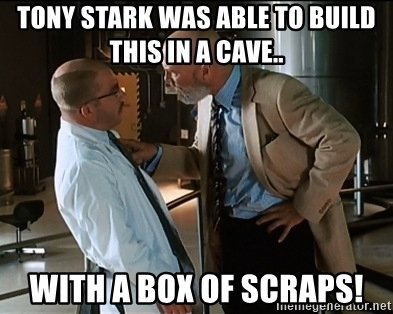
But he is extremely fun, and campy in this very old-school way that I don’t think was entirely intentional.
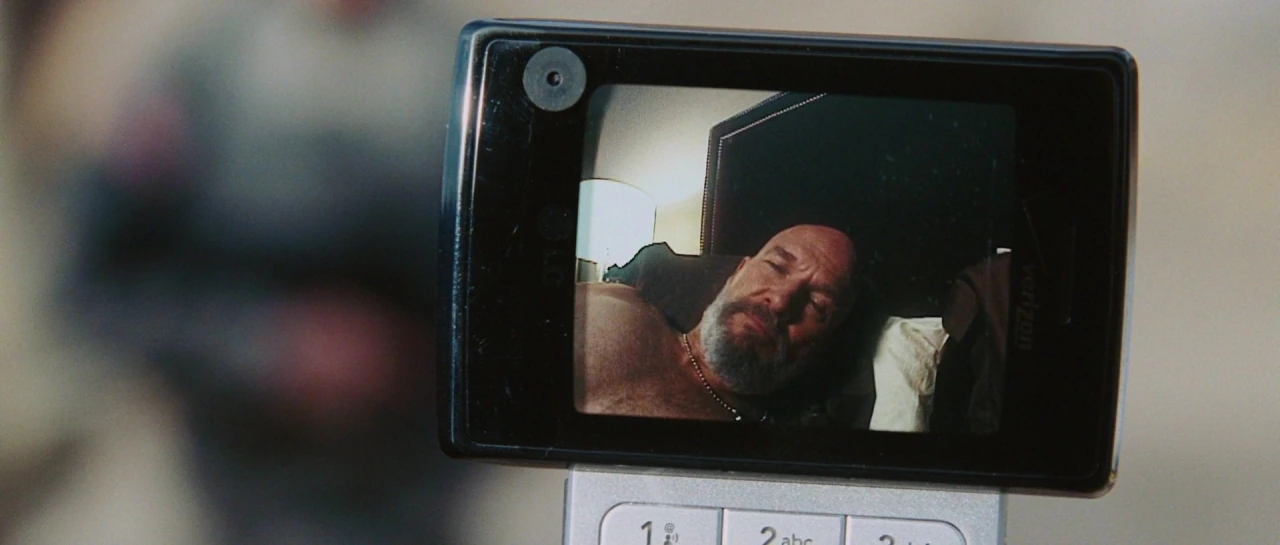
Like, look at this guy. Maybe this is a relatable experience to only a small handful of the people reading this, but that’s an older Daddy if ever I saw one. This queen is vegan. He loves Drag Race. He’s an ethical stone-top Dom who exclusively dates guys ten years younger than him, and I’m here for it. I look into his face, and it makes me feel like a twink again. I think this accidental queer-coding of the villain is a real product of the time, and not something the movie should be applauded for, but Stane is fun for what he is. What he is, though, isn’t really much of a character. His motivations seem to be entirely limited to making money, and there isn’t much to his identity besides that and a healthy amount of ruthlessness. The guy is just unabashedly evil, and very smug about it. Jeff Bridges does most of the heavy lifting with Obadiah; the character isn’t fleshed out enough to be interesting, and so instead you have to rely on a brilliant actor’s inherent charm and charisma to bring him to life. He has none of the pathos of Doc Ock in Spider-Man 2 (2004), none of the humanity that makes that villain real. Iron Man (2008) can suffer no characters but Tony Stark, and so the villain is reduced down to serving a narrative function and being sufficiently entertaining while doing so.
Lastly, from a technical standpoint, the movie holds up really well. The CG isn’t overzealously applied, only where it’s necessary, and for the most part it looks as believable as it can. The effects don’t stand out, there’s nothing that really blows my mind anyway, but it's competently done. That’s a word I’ve used a bunch at this point already: “competent”, and it is I think how I would classify the movie overall. The writing, the plot, is competent. It’s a little common, featuring pretty stock villains and stock plotlines, but it works. The script is perfectly acceptable, none of the lines come off as particularly dorky or clumsy, and the cast (the real strength of the film) deliver them well. The pacing is fine, the action sequences are fine but not standout, and the characterisation of the villains is weak but still entertaining. Insofar as Iron Man (2008) has a goal: to promote and establish the character of Tony Stark, it is in this capacity also entirely competent. It does, by the end of the movie, build a character. All the little building blocks fit together. Granted, this has come at the expense of every other character, so there’s little else for a viewer to latch on to, but the characterisation is well done and achieves what it wants to achieve. I can identify nothing particularly groundbreaking, nothing that particularly wowed me, but I could watch it for 120 minutes and I did not hate a second of it. I remained within my seat.
Keeping me in my seat, is, I think, exactly what the movie wants of me, or indeed of any viewer. Maybe it's cynical of me to think that Iron Man (2008) was functionally just a vehicle for the MCU, and as such supplicated itself before the golden idol of financial viability. But, given what the MCU became, I think such cynicism is warranted. Had I the time, or desire, I might go hunt down interviews with Kevin Feige or Jon Favreau to see what they have to say about Iron Man (2008) as being a starting point of the cinematic universe. Maybe I’ll do that in the future. But for now, going exclusively by the text presented, it's plain to see that Iron Man (2008) did not just plan to have sequels, as might have been expected, but plans to tie in to a whole network of movies. For one thing, you have Rhodey, who will eventually become known as War Machine. As the movie is coming to a close, Rhodey is sent by Iron Man to accomplish some task or another. I think the specific command was to “keep the skies clear”, so that he and Obadiah can fight it out without interference. On his way to do so, he passes by a build of the Iron Man suit, the one that’s all steel coloured (War Machine, of course, will eventually wear a steel coloured super suit). After passing it, he looks behind him and says out loud, “next time”. Right there, in the text, the movie is telling you “Watch out buddy! We have Sequels! Maybe even ones with this guy!”. The nature of these sequels is unclear, the assumption at the time would likely have been that this is foreshadowing a second Iron Man movie. Even outside any considerations of a cinematic universe, Iron Man (2008) explicitly calls itself out as a vehicle of capital: all movies have advertising and productplacement, sure, but this one is advertising future versions of itself. Having placed the idea of sequels into the audience's head, the movie proceeds, right at the death knell, to change everything up. It gives us a post credit scene.
I don’t want to talk too much about the post credit scene here, as I intend to have a little post credit scene review at the end of each of these blog posts. But for the briefest of brief summaries, Tony Stark comes home to find Nick Fury in his room. Nick introduces himself as the director of S.H.I.E.L.D. and says he’s looking for recruits for the Avengers Initiative. Talk about a marketing ploy. I’d contend that mass social media was still in its infancy, so while there’d be a couple tweets and forum posts, the main way for word to get out about it at this early stage was for the handful of freaks who stayed in the theatre until the very end to be suddenly surprised with the face of Samuel L. Jackson. They, naturally, run outside and tell or text all their friends: “We stayed until the very end and there was a secret scene!”. These friends then rush to the theatre, comically large wads of cash in hand, to throw money at the clerk in exchange for tickets to see this surprising, hidden, Easter egg. Or at least, that’s how I imagine it went down. The point is, this is pure marketing; the movie makes you want to see and be invested in this post credit scene, it draws people in. The message of this scene then hits harder: The Avengers Initiative is coming. Some number of comic nerds could probably start putting the pieces together, but given the Avengers relative lack of popularity prior to the MCU, this one was for the super-nerds. The Avengers are an ensemble cast, like the Justice League, a bunch of heroes all coming together. It was unlikely at the least for this Avengers teaser to be related to an Iron Man movie, but here it was, being teased in the Iron Man movie. Thus, the floodgates were opened, and the possibility of a new franchise of interconnected yet independent movies came crashing in.16
I’d like to include a note from Seán here: “If we're talking comic book fans, they'd been calling for this for years - there were plans for a while for a Fantastic Four/X-Men crossover, with some remnants of it in deleted scenes, but then when X-Men: First Class was successful they rebooted Fantastic Four and made Days of Future Past instead. The interconnected universe wasn't a new idea, it wasn't even the first time it was teased - this just happened to be the one that worked.”
Iron Man (2008) marks the launch of the MCU; the first successful launch of a new way of producing and consuming media, that comes at a time of major social and political upheaval. I do not know how strongly Marvel believed in the MCU’s potential, but what is certain is they wanted to give their project a fighting chance. I think this is a large part of why Iron Man (2008) is the way it is: a competent, but safe, superhero action movie. It hits many of the beats of what a good superhero movie might look like, and in doing so, presents an easy vehicle for the marketing and launch of their project, ensuring as many eyeballs get on it as possible.Additionally, I think this impacts the plot and construction of the movie: if the goal is to begin a new project, why not have it start with the firm establishment of one of its key characters? Iron Man (2008), despite being a feature length film, is only the first chapter. It is designed to hook people, to entice them. But to do so, it must at least pass as a completed novel, as a solid movie that can stand on its own merits. It manages this pretty well.
War Machine. Not that War Machine.
I have no intention of making this entire blog, or at the very least the sections on contextual analysis, about politics. I will invariably talk about politics a lot (it’s kind of hard not to when you’re dealing with the MCU) but I am aware that other modes of cultural and contextual analysis exist, and I intend to employ them. Luckily, I have a whole two more Iron Man movies to go, so I’ll leave all that to later. For now though, it’s all aboard the politics train; let’s take ourselves back to the dying gasps of the Bush administration.
The arc (reactor) of the Bush admin is not something I’m incredibly familiar with, please see my previous statements about how I am neither a cultural critic nor a historian of the early 21st century. I was a child for most of it, and I am not gripped by the complications it engendered in the same way some other people I know are. But, undeniably, the conflict in Iraq and Afghanistan that took centre stage for much of George W. Bush’s 2000-2008 presidency is an extremely complicated event. The Council on Foreign Relations lists the war in Iraq and Afghanistan as lasting from 2003-2011.17 That’s eight years of war crimes, human atrocities, suffering a death, and trying to unpack all of that in addition to the geopolitical context surrounding it would require far more than a single blog post. I will, however, do my best to give an account of it, and the ways in which Iron Man (2008) both draws inspiration from the war and plays into the mythos surrounding it.
https://www.cfr.org/timeline/iraq-war
The campaign explicitly begins in 2003, nominally under the pretence of attempting to find and confiscate the “Weapons of Mass Destruction” (WMDs) in Iraq’s possession. The initial invasion is made up of a coalition composed primarily of US and British forces, and the Iraqi army is capable of little resistance. The ground assault and initial invasion take only a couple of months, and having began the campaign in March, by early May a victory is already being announced by the US. However, despite these early victories, the US and other forces get bogged down in a peace-keeping and counterinsurgency operation; trying to keep a grip on the territory while also hunting for the elusive WMDs. These never do materialise, and support for the already increasingly unpopular war drops even lower. There are a handful of small victories for the US and their interests here and there, such as the trial and execution of Saddam in 2006, but generally speaking little progress is made. By the time 2008 rolls around, momentum behind the war is fading. Polls conducted in November 2007 indicated that over half of Americans wanted the war to end, and in the race to become the Democratic nominee, Barack Obama’s anti-war position was decidedly favourable over Hillary Clinton’s early support of it.18 The reality appears to be that, as production of Iron Man (2008) was underway, and surrounding the time of its release, public opinion was not on the side of the warmongers.
https://www.pewresearch.org/politics/2023/03/14/a-look-back-at-how-fear-and-false-beliefs-bolstered-u-s-public-support-for-war-in-iraq/
The movie, however, is set in Afghanistan. For the bulk of the movie, it seems that the villains will be the Ten Rings – an allegory for Iraqi and Afghani insurgent groups. They are depicted precisely as you would expect them to be; dressed in dusty military fatigues and hiding out in an underground bunker. When Tony is captured, there is a scene of him emerging from unconsciousness while tied to a chair. Someone is rapidly speaking Arabic, and as the camera zooms out, it is revealed that he is surrounded by masked soldiers and is being filmed; a scene reminiscent of actual videos released by insurgent groups of their hostages. There is no ambiguity here, nor, I think, is there meant to be any ambiguity. Iron Man (2008) very purposefully positions itself in the setting of the conflict in the Middle East; amongst the sand and the uncertainty, and it has a great deal to say about it. There are three main elements related to this conflict that I would like to trace: firstly there is the relationship of Iron Man (2008) to the US military, secondly there is the relationship to weapons manufacturing and the ethics involved in it, and lastly there is the relationship of the movie to the war itself.
So to begin with, let’s talk about how the US military are treated and represented. Right from the sound of the starting gun, Iron Man (2008) confronts the audience with military personnel. They ride with Tony in a van across the countryside of Afghanistan, laughing and joking with him, as I discussed at length in the plot synopsis. The US military are also the ones to rescue Tony; he of course saves himself by busting out of the Ten Rings bunker, but when he lies lost and alone in the desert, it’s the military that comes to his rescue. Tony is treated with respect and reverence by the US army, both because of his genius and his importance to them as an arms dealer, but that is not the extent of their relationship. The closest thing Tony has to a friend in the movie, Rhodey, is a ranking member of the US Air Force, and someone we are clearly meant to like or at least be sympathetic towards. Additionally, the movie is peppered with displays of the military's force. On a handful of occasions, we are confronted with large, sweeping shots of US army bases: soldiers moving about with order and purpose, and colossal, impressive engines of war in the form of tanks and planes. It is difficult to watch the scene in which Tony is pursued by two US Air Force aircraft without thinking, even a little bit, “wow they really want to show off how sick these fighter jets are huh?”.
The effect that this has is to produce an image of a US military that is subservient, benevolent, but also extremely powerful. Their subservience is communicated both through their deference to Tony, but also because they are portrayed as simply being there to do a job. Tony has a functional command over the US military personnel he interactions, not just because of who he is, but because of his friendship with Rhodey. The military laugh at his jokes, he walks around military training facilities like he works there (he doesn’t), and most importantly they always do what he asks. If Tony needs “the skies kept clear” so he can square up against his Gay Uncle Obadiah Stane, the US military is ready and waiting to make that happen. Of course, this creates a tie between the hero, the good guy of the film, and the US military. Benevolence, acting in a morally virtuous or righteous way, is made part and parcel of the military's identity. They transport Tony around and rescue him when he’s in danger, all while having big, cool, impressive planes. To my memory, there isn’t a moment where they ever actually fire a shot. All the violence and murder is left to the Ten Rings, or to Iron Man. As far as the movie is concerned, the US military functions more like highly skilled and well-equipped firefighters. They’re just there to make sure nobody gets hurt, but of course, they don’t want you to forget that they could easily hurt you if they wanted to. The US military in Iron Man (2008) have all the appearance of a caged lion. They are proud, respectable creatures with a great capacity for violence, but they are kept safely behind glass. As much as you are confronted with their nobility, you are asked to forget about the reality of what they are.
I don’t think it’s a surprise to anyone that Iron Man (2008) received funding from the Pentagon, and worked closely with the US Air Force. I did a tiny amount of digging into this, and luckily for me British journalist Tom Secker has over the past years been filing freedom of information requests for correspondence between Hollywood and the Department of Defence (DoD), many of which are available on his website.19 In the communication between Marvel Studios and the DoD regarding Iron Man (2008), an Air Force Captain was assigned to the movie to be present for scenes featuring the Air Force, and the screenplay was given to the DoD for approval. This, amongst other items listed in the document, is stark (get it?) evidence of a heavy involvement of the DoD in Iron Man (2008)’s production. It can only be assumed that the representation of the military I have just described is one that the actual military were happy with, and ultimately signed off on. This, I think, clarifies the extent to which Iron Man (2008) is a movie demonstrative of the changing attitudes towards the US military found in 2008. A macho, gung-ho, “root out and kill the bad guys” approach to military propaganda just wasn’t going to cut it anymore; popular support for the war in the Middle East was dying off. So instead, I would argue, they position themselves as simple, hardworking guys and gals. They may have the manpower to destroy whole nations, but at the end of the day, they’re just there to keep people safe.
“Keeping people safe” is, perhaps intentionally, also a tagline the movie associates with Stark Industries. The weapons they produce and sell are, ultimately, for the purpose of keeping the peace. If the bad guy has a big stick, well you sure as hell need a bigger stick, or else god knows what he’ll try. At the beginning of the movie, I thought that this kind of justification would be present throughout the movie. In the early scenes, neither the movie nor Tony seems to particularly care about what he does: of course his products kill people, but the profits those products make can be put into useful medical and scientific development projects. This hand-waving of the ethical issues inherent to weapons manufacturing is only challenged by Christine Everhart, who I mentioned before, but she is robbed of her moral and journalistic integrity when she agrees to sleep with Tony. If she’s willing to have sex with him, surely she can’t hate him that badly, and surely all her hand wringing and outcry doesn’t actually have any substance behind it. This whole sequence seemed to me as proof of the movie’s pro-war profiteering stance – the only critic of the practice is depicted as a fickle liberal who either doesn’t understand the reality of weapons manufacturing, or is only pretending to care so she can attack a successful billionaire.
https://www.spyculture.com/pentagon-production-assistance-agreements-iron-man-12/
However, this is not a position that the movie sustains for any great length of time. Tony being confronted with the reality of war profiteering and the evil of weapons manufacturing is what motivates him to become Iron Man, and when he goes home he shuts down the whole weapons manufacturing side of the industry. Similarly, Obadiah Stane’s desire to continue building weapons is what positions him on the evil end of the film’s personal moral compass. Furthermore, the Jericho Missile, the only weapon of Stark Industries that is displayed with any real detail, is shown to be devastatingly powerful. It destroys landscapes and townships with terrible ease, and while its launch is visually impressive, I believe the intent is to demonstrate both the genius and the horror of what weapons manufacturing is capable of producing. To the movie’s credit, I think this is pretty neat. Or at the very least, I didn’t expect it to go this way. It builds up to what you anticipate will be a defence of the whole weapons industry, only to tear that down rapidly, which leaves a sense of shock and surprise that I think intentionally mirrors the experience that Tony himself goes through. There is an admission that the manufacturing of weapons is not, ultimately, a reasonable way to keep people safe. Despite appearances, I think Iron Man (2008) is fairly solidly an anti-war profiteering movie, but it’s just not an anti-war one.
The position of the movie is less that war and its consequences are bad, but rather, that there is an ethical division between those who can (and should) participate in war, and those that should not. At no point does Tony Stark, Pepper Potts, Rhodey, or any prominent civilian or military character disavow what’s happening in Iraq and Afghanistan. If anything, the violence that Tony flies to Afghanistan to conduct himself is seen as perfectly legitimate. Without oversight or jurisdiction, Tony shoots across the globe and starts opening fire, and this is presented as a worthy cause and deserving of celebration. Within the morals of the movie, this is a good man eliminating bad people who did bad things. While there is a complexity regarding weapons manufacturing, and an acknowledgement that the bad guys are just as capable of acquiring guns as the good guys are, this complexity is not extended to the violence conducted against Ten Rings. Just like Obadiah Stane, they are depicted as villains, pure and simple, and there is a lack of recognition of the possible complications related to insurgent militias in the Middle East during the Iraq war. Ultimately, this simplistic rendering offers a simplistic picture. The horrors of the Iraq war are bad and innocent people, represented by Yinsen and the people of his village, suffer as a result. But it must be remembered that there are villains out there, who wish only harm on others and have no morally justifiable position, and they are worthy of extermination.
Iron Man, the character, is wrapped up in layers of power, violence, and war. The suit Iron Man wears is a suit built out of war; a suit intended to deliver violence upon the wearer's enemies, constructed in an active war zone. It is a suit built and worn by a longtime war profiteer, who, in the process of its refinement in the safety of his own home, discovers and rapidly embraces the suit’s destructive potential. Its wearer wields both the respect and the friendship of high ranking military personnel, who work with him and for him at his request. And as this is the character that Iron Man (2008) so completely wishes to be about, it is therefore completely all about war. The vision of war that it presents, however, is a warped one, and heavily informed by the officials of one of the largest militaries on the planet. In the wake of a shifting attitude towards the US military and the conflict in the Middle East, Iron Man (2008) offers a vision of war in which its horrors, and its crimes, are perpetrated by genuine bad actors; by soulless amoral insurgents, and by soulless amoral weapons manufacturers. In opposition to this, it offers the ethical warmongers: War Machines with a heartbeat. Firstly, there are individual actors characterised by Tony Stark. In legitimising his acts of violence on account of his “goodness”, the movie implicitly voices support for the idea that war and violence can be conducted by powerful billionaire beneficiaries of capital, who as a result of their own genius, can operate without restraint. Tony is a “good guy” by the end of the movie, ensouled and more caring than he once was, and so he can be handed the reins of violence. Secondly, and acting as the supporting cast to the empowered genius individual, in the army. But the army is positioned here not as the main agent of violence, but rather in a support role. With the thoughts of war crimes and human atrocities far from their innocent minds, these soldiers exist solely to keep the peace and to lend aid and opportunity to Tony Stark. Unlike the weapons manufacturers, the military are the real agents of “keeping people safe”.
Contextual Analysis Conclusions
In 1937, Disney Studios released their first feature length animated picture; Snow White and the Seven Dwarves (1937). This release of this film is a seminal moment not only in the history of the animation studio, but in the history of Hollywood; launching Disney into the limelight of movie making.20 It was unlike any animated movie that had come before it, exploring a range of artistic and animation techniques that would open further possibilities for iteration and improvement in the genre. For this reason, it has been referred to by both film critics and Disney themselves as “the one that started it all”; a landmark release in the history of 20th century film production.
https://iftheglassslipperfitsblog.wordpress.com/2016/06/03/the-one-that-started-it-all-designing-disneys-first-princess/
Iron Man (2008) is the Snow White of the 21st Century. Regardless of one’s feelings on the movie or the MCU as a whole, Iron Man (2008) is the first of its kind, and the movie who’s financial success enabled the birth of 34 other movies, in addition to a range of other television and literary titles. However, unlike Snow White and the Seven Dwarves (1937), Iron Man (2008) does not share any of the same artistic innovation, or certainly not to the same scale. It is, by necessity, a safe and pedestrian movie; sitting comfortably inside the boundaries of what is expected for a picture of its genre to maximise the likelihood of its international appeal. To be overly criticised, to be shunned by a significant percentage of a potential audience, would be a disaster scenario for the fledgling work of Kevin Feige. While the Snow White movie and the other early animated work of Disney Studios were both financial successes and expanded the scope of their medium, Iron Man (2008) is “the one that started it all” only insofar as it allowed for the acquisition of an absurd amount of money.
I have attempted to argue that Iron Man (2008) comes at a time of political and social upheaval; a time in which human attitudes towards politics, society, culture, and to each other were beginning to undergo major shifts. As a movie, it is reflective of these shifts. The shockwaves of the surrounding culture reverberate within; from the edgy attitudes of its hero desired by 2000s audiences to its naïve perspective on war and violence, Iron Man (2008) is indicative of the culture that was to emerge from this point in history onwards, and in ways, plays a significant role in creating them.
Final thoughts
This post is far too short. I have spent almost exactly a week thinking and writing about Iron Man (2008) and have gotten very little other work done, but I promise you there is still so much more that I have left to say. In the contextual analysis section, I spoke about the financial pressures that existed on the movie, and how that contributed to necessitating its mid-ness. I also got to talk about the movie’s relationship to war, a theme that I am confident will re-emerge over the course of this project, especially once we get to Captain America (2011). I also go on a brief diatribe about Tony Stark’s relationship to the construction of modern masculinity and loneliness, and got to call Tony a Sigma Male, which is something I desperately wish to revisit. All of this was only scratching the surface though. I could write several thousand words on Tony’s relationship to gender and sexuality alone, or on the relationship between man and machine the movie traces (which I barely even got to discuss). But the post has to end somewhere, and insofar as Iron Man (2008) is a starting point, I think I got to cover what I felt were the most central to the scaffolding of the MCU. That said, if anyone wants to listen to me talk more about Iron Man, you’ll have to wait until my blog post on Iron Man 2 (2010), or just hit me up on Discord or Bluesky or something.
I was sitting in the park just a few hours ago with a friend of mine, and was subjecting her to my closing thoughts on the movie, now that I’ve spent so much time sitting on them. She said that this movie, Iron Man (2008), seems like the kind of movie that will be on college courses on early 21st century culture, and I could not agree more. It is such a rich, and deeply important text. Not only is it the first movie of the MCU, a dominant cultural force, and not only is it the only major motion picture to be referenced as a global event on Wikipedia until 2023. But it is also a movie fundamentally related to new beginnings, to shifts in modern cultural identity and thought, that comes at a time when modern cultural identity was in the infancy of its formation. It has so much to say, both intentionally and unintentionally, about this period, and offers such a wonderful mirror for reflection that I genuinely believe we are still yet to grasp the full extent of its relevance to modernity, and may not grasp it for several decades.
If you made it this far, thank you so much for reading. I hope you liked it.
:3
Post Credit Scene Review
If Disney can do it then so can I; the train never stops, it just keeps on trucking. Just when you thought it was over, just when you thought you had seen everything there was to see, here comes a whole new section.
I intend at the end of every blog post to do a post credit scene review. In the body of the post I’ll try to steer clear from talking too much about whether I liked a movie or not. I don’t really want to give the movies a score or rating, I just want to think and talk about them. Here though, looking at the shit that comes round after we’ve learned who the Best Boy and Gaffer are, this is where the critic comes out.
So, after Iron Man (2008) is all done and dusted, we are surprised by a shot of a room in Tony’s super mansion. Might be his bedroom, might be his living room, I can’t really remember. I do hope it’s his bedroom as that adds a whole layer of sexual tension, but let’s put that aside for now.21 The atmosphere of the room is dark, mysterious even; white furniture standing out against the dark room and nighttime landscape that can be seen outside the floor to ceiling windows. A man stands in the shadows, and as Tony steps in and sees him, he calls out to ask who he is. Samuel L. Jackson steps out, the camera focussing on his face. “I’m Nick Fury, Director of S.H.I.E.L.D., I’m here to talk about the Avenger Initiative”, is basically what he says, and then boom, it's over. Credits don’t roll as they’ve rolled already, but metaphorically, the credits roll.
My housemate Seán said it best, this is the platonic ideal of the post credit scene movie. It’s got atmosphere; there’s a weight in the air, and there’s a stank to it. The scene has funk is what I’m getting at. A character from the comic books is introduced: Nick Fury wasn’t in the movie, he had nothing to do with the movie, but now all of a sudden here he is? That’s crazy. And not only is he here, but he has a new piece of information for us: a clue as to what might be coming next and the promise of a continuation of the story that began in this very film?
Oh yeah baby, this one has it all. Slap some ears on Kevin Feige and call him the Easter Bunny, because this is the Easter Egg to end all Easter Eggs.
Happy hunting. See you for The Incredible Hulk (2008).
It's his living room.